
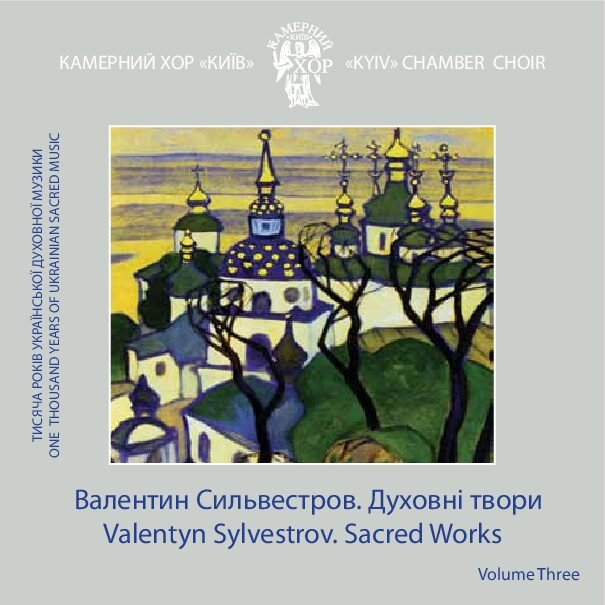
Valentyn Sylvestrov. Sacred Works
- Release: Kyiv Choir Productions
- Released: 2013
- Sound Engineer: Andrij Mokrytskij
- Cover: Painted reproduction by Iurij Khymych "Vydubychy Monastery. View from the west". (Gouache. 1981)
Alleluia
Valentyn Sylvestrov
Seven spiritual songs (2005) 15:07
1. Alleluia 01:45
2. Cherubic Hymn 01:25
3. Gloria 02:42
4. Cherubic Hymn 02:27
5. Holy God 02:28
6. Alleluia 01:41
7. Many years (Vivat) 02:39
Five spiritual songs (2008) 13:11
8. Cherubic Hymn 03:36
9. Alleluia 02:00
10. Many years (Vivat) 02:40
11. Alleluia 02:37
12. Many years (Vivat) 02:17
Four spiritual songs (2009) 10:39
13. Our Father 03:27
14. O Virgin Mother of God 02:26
15. Cherubic Hymn 02:12
16. Alleluia 02:32
Three spiritual songs (2008) 07:12
17. Alleluia 02:56
18. Many years (Vivat) 02:28
19. Cherubic Hymn 01:48
Three spiritual refrains (2010) 12:49
20 Cherubic Hymn 03:37
21. Psalm of David 23 04:26
22. Eastern Psalm 04:15
Two spiritual refrains (2010) 06:35
23. Psalm 03:51
24. Alleluia 02:45
Two spiritual songs (2008) 07:11
25. Alleluia 03:16
26. Many years (Vivat) 03:54
Two spiritual songs (2010) 06:06
27. Cherubic Hymn 03:30
28. Many years (Vivat) 02:35
Total time 78:28
About the album
In Sylvestrov’s choral works contours of ancient genres emerge as ifhandwritten on ancient parchments –palimpsests, particularly in the case of the Liturgy and the sacred concerto. Yet the pseudo-ritualistic situation and the canonic order of the texts are relegated to the background; more important for the composer is the focus, the introspection, and the detachment from ourquick paced environment. Thus, «Seven Sacred Songs» (2005) remind us of the Liturgy: the cycle consists of two Alleluias (which traditionally precede or follow key moments of the service), two «Songs of the Cherubim» (which introduces the liturgy of the faithful), two «Thriceholy» hymns, (part of the liturgy of the catechumen) and Wellwishing. However their ritual order in the service is not maintained: «Glory be to the Father» and «Holy God», which belong to the liturgy of the catechumen, appear not before but after the «Song of the Cherubim», and only the general outline of the liturgy – its beginning and end – is suggested by the «Alleluia» and «Well-wishing». Reordering the liturgy of the faithful freely is exemplified in the cycle «Five Sacred Songs» (2007) («Song of the Cherubim» – «Alleluia» – «Wellwishing») and «Four Sacred Songs» (2009) («Our Father» – «Song of the Cherubim» – «Alleluia»). Distinct, – as it were «ritual», applications of service order (as, for instance, the use for key momentsin the service of «Alleluia» and «Wellwishing», the latter of which is used in Orthodox churches at the end of the liturgy) give rise to Sylvestrov’s independent microcycles — «Two Sacred Songs» (2008, 2010). And in all casesthe composition is free from ritual restrictions; the composer creates his own world, in which the sacred Word is the impulse, and the whole is compliantnot with the ritual, but with self-fulfillment and self-expression. However, thisremembrance of old genres is not just a membrane that simply envelops Valentyn Sylvestrov’s choral universe. His essential meaning exists in the intonational dimension. His reverberating intonations create a many-dimensional musical space – in every «Well-wishing» resounds a recollection of the Psalms of David, and «Our Father» resonates with the sameresilient fluidities as the «Songs of the Cherubim». And everywhere the listener can expect luxurious Melos – organic, natural, nuanced, rich in allusions; lyrical and at the same time stern, vocally cantilena-like — and also instrumentally colorful. The jubilati of church chants propagate throughout the weavings of polyphonic texture, and the chant-like strings of parallel thirds unite with romantic linguistic intonations. This Melos arises like an echo from the initial chords; it grows, branches out, creating amazing sonorous configurations.