
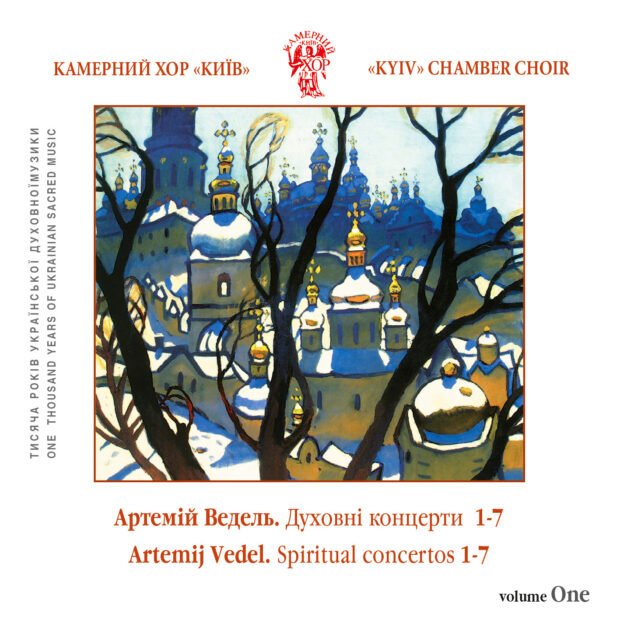
Artemij Vedel. Spiritual concertos 1-7
- Release: Kyiv Choir Productions
- Released: 2007
- Cover: Reproduction painting by Yurij Chymych "Kyiv Monastery - Sunny Winter". (1990. Gouache)
- Sound Engineer: Andrij Mokrytskyj
Concerto No.3 "Till when, O Lord ", Part 2
Artemij Vedel. Spiritual concertos 1 – 7
Concerto No.1 “In the prayers of the ever vigilant Mother of God” 7:22
(Kontakion: Dormition of our Most Holy Lady the Theotokos and Ever-Virgin Mary)
01. Adagio
02. Andante
03. Allegretto
Concerto No.2 “Save me, O Lord God” (ps.2: 2) 9:32
04. Adagio. Allegro maestoso
05. Adagio
06. Allegro
07. Adagio
08. Allegro
Concerto No.3 “Till when, O Lord” (ps.12: 2) 12:48
09. Andante
10. Adagio
11. Andante
Concerto No.4 “I Sing to and praise my Lord God” (ps.145: 2) 15:07
12. Maestoso
13. Adagio
14. Allegro vivace
15. Andante
16. Allegro vivace
Concerto No.5 “Blessed is he who believes in the Lord” (ps.40:2) 12:05
17. Adagio
18. Andante
19. Allegretto
Concerto No.6 “Lord , have mercy” (ps.6: 3) 12:48
20. Adagio
21. Allegro
22. Adagio
23. Allegro vivace; maestoso
24. Adagio
25. Allegro vivace
Final concerto No.7 “Resurrect, O Lord God” (ps.9: 39) 2:36
26. Allegro maestoso
Total recording time 72:37
About the album
The second half of the 18th century became the “golden era” in the history and art of Ukrainian choral music. The creations and works of such well known masters, as Maksym Berezovsky, Dmytro Bortniansky, Artemij Vedel elevated Ukrainian music to its highest spiritual orbits, which still to today is perceived as an assured aesthetical ideal. And all this came about at the time when Ukraine lived under the brutal, ferocious and cruel national oppression of Russian Imperialism, and by Catherine the Great’s ruination of the last defensive military bastion of Ukraine – the Cossack Zaporizhian Sich. A large number and stream of Ukrainian youth, namely musicians relocated to Russia, primarily to fill monastic choirs, court choirs, private capellas, and theatres. Such a fate did not bypass one well-known Ukrainian composer of that time. All of them in some form or another presented their talents before the altar of Russian culture. The creativity of these composers afforded great influence and expansion of professional music for successive generations, so it is not surprising, that two great nations – Ukraine and Russia
claim these composers as their own national geniuses…And yet they returned to Ukraine, even individually. Amongst them was Artemij Vedel, to whom fate bequeathed the title of the most magically fascinating, and yet simultaneously, the most tragic star of Ukraine. For in the 18th century, there was no better composer, nor better singer, and no better conductor-kapellmeister. No better enigmatic figure also….
Artemij Vedel (1767-1808) – eminent Ukrainian composer. Vedel was a brilliant conductor, singer (tenor), violin-virtuoso and musical pedagogue-teacher. So much talent for one person, and for one so filled with tragic fate. At the age of 32, and full of creative thought, experience and knowledge, he was imprisoned in a madhouse, where he spent nine terrible and horrific years. His life ended aged 41, yet the tragedy of the artiste lasted long after his death: as publication and performance of his works was forbidden. 50 years after his death saw his first condensed biography. Centuries later, the first publication of his works. This short revival and renaissance quickly reversed almost a century of official isolation, this time under the Soviets (USSR). Yet Vedel’s music continued to live and be performed, as the nation preserved it, and because it was born of great love to Ukraine.
Artemij Vedel studied at the Kyiv-Mohyla Academy. In his student years he distinguished himself as a soloist, church choir director, first violinist and orchestral conductor. “The singing of Vedel’s academic choral choir was brought to the highest levels of perfection. Adornment of this choir was Vedel himself through his great tenor, which enraptured all of Kyiv. His personal glorification, and recognition as a choral conductor and singer soon spread far beyond the boundaries of Kyiv.” – wrote V.Petrushevskij in 1901. Soon after, Vedel was invited by the kapellmeister and governor’s Capella to Moscow (1788-1792), where he also, under false documents, lectured in universities, and received lessons from the Italian composer Giuseppe Sarti, whilst communicating with the well-known Russian composer of Ukrainian descent – S.Dechtiarov. Without doubt, in Moscow the young artiste wrote a whole host of musical works, which – as can be established and conjectured, were not all retained in their autobiographical appearance, as some remain undated.
At his own behest, Vedel relieves himself of his duties. Upon his return to Kyiv, there began the most productive period of his creativity. In 1794-1796 he directs the Corps-Capella of General A.Lavanidov in Kyiv, and later in Kharkiv (1796-1798), to where he moved because of his patron’s orders to relocate, and take up new duties. In Kharkiv the composer, besides choral conducting, lectured again in music and song at the Kazen School, and later – prepared a small choral group for the Petersburg Court Choral Capella. The reforms of Pavlo1st, who sat on the Russian throne after the death of Catherine II on the 6th November 1796, instigated a staged restriction and tightening of Vedel’s sphere of activity, which forced him to resign (as the composer held the rank of captain), and to again return to Kyiv (end of August 1798). From autumn of that year began the last, and very short period of the composer’s creative work, which culminated with the scoring of two mighty, and deeply dramatic spiritual concertos – “O God the proud have risen against me” and “To the Lord I always bow,and walk His ways”, which were performed by the Kyiv Brotherhood and Sofia Monastery Choirs of Kyiv.
In January 1799 Vedel becomes a servant-novice at the Kiev-Pecherska Monastery. After a short period of time, he secretly leaves the monastery. On the 25th May 1799 Vedel was arrested on the order of Pavlo1st, and imprisoned in a building for the insane. This was eternal imprisonment, and its reasons to this day initiate contention, and sharp academic discussion. Vedel’s student and friend, the famous composer and singer – the Very-Reverend P.Turchaninov proclaimed his teacher righteous, referring and mentioning him as an exceptional, thoughtful, considerate, sensitive and deeply religious person. With deep sympathy to his oppression, depravity and ill-fortune Vedel initiates a letter to P.Turchaninov. A harsh judgement of untruth, hypocrisy, and brutal harshness can thus be “read-into” in the last autobiographic concertos of the composer. For it seems as though the humanitarian and worldly-views of the artiste could have been the reason for his pungent confrontation with the authorities.
Fate gifted Vedel a short life, yet in which he found the time, and succeeded in producing an unrepeatable contribution to the wealth of Ukrainian and worldly musical arts. V.Askochenskij wrote Vedel’s first biography in 1854: “I know, and myself sang the concertos of Vedel, and speak with certainty, that not in one of our spiritual composers existed even half of the depth of feeling, which this exceptional person possessed. I think, that every concert scored by Vedel cost him many, many tears …” Deep national, dazzling images, emotional nourishment of his music, today, as two hundred years ago, troubles, excites, stirs, extracts tears, and yet brings peace. The embodiment of a diverse gamut of emotions, unveils a complex, dramatic and simultaneously lyrically open world of an exceptional person, and great humanist. With regret, the creative legacy of Vedel was not preserved in its totality. Known are the sections relating to – 28 Spiritual Concertos (*Today the author’s attribution of five of them has been revised. Concertos No. 15; 22; 24; 25 and 27 are considered to be by S. Dekhtyarev), 2 Divine Liturgies, the All Night Vigil, three Hiermos cycles, and separate creations based on canonical texts. Their style is formed on the intermissions of baroque, classical, pre-romanticism tendencies, thus formulating a complex synthesis, which clearly experiences the senses and influence of traditional Ukrainian and Western-European music. Vedel’s creations differentiate themselves through their unity of word and music, melodic sincerity, rhythmic complications, multi-layered textures and techniques, refined perfection of small form, and yet with it – define the mastery and monumentality of his Choral scoring and writing.
On this compact disc the Chamber Choir “Kyiv” presents the spiritual concertos from the Vedels’ unique autobiographical works (No’s. 1-7).
Concerto No. 1 “In the prayers of the vigilant Mother of God” (1794) – was devoted to the triumphal Divine Service honoring the Dormition (falling asleep) of the Mother of God as sung in the Kyiv-Pecherska Lavra-Monastery. The concerto discerns itself through its laconism, dynamism, and the melodic baroque sincerity in the middle section.
Unity of lyricism, sadness, melancholy and their respective image spheres distinguishes Concerto No.2 “Save me, O God” – in that the tracking of micro-transformations with the foundations of intonation from the opening theme, unites Ukrainian song to the dynamic theme of the final fugue.
The acknowledged masterpiece from Ukrainian classical music – Concerto No.3 “Till when, O Lord”, duly impresses through its impenetrable intuitiveness, baroque images of death, manly stoutness and dramatics of the tenor solo, which are genetically tied into the melodic-rhythms and improvisation of Ukrainian thought.
Concerto No. 4 “I Sing to and praise my Lord God” draws one’s attention to its beauty, as the ensembles demonstrate an emotional uplift from its unfolding lines of the top voice and Cantor techniques – filled with rhythmic imitations.
The first section of Concerto No.5 “Blessed is he who believes in the Lord” is typical of a Vedel concert, as it is based on well chaptered themed-sentences, interpreted in a lyrical duet of alto and tenor, which futures dramatic developments through canonical imitations of choral tutti. The end of the concerto is unusual in that it is built on the Andante tempo, and its intonational relationship with the first tempo of the finale.
Artistic heights are represented in the group work – Concerto No. 6 “Lord, have mercy” – which is one of the most popular of Vedel’s works, which in the 19th century, and as testified by V. Askochenskij, “circulated all Orthodox Rus “. In this great seven-sectioned cycle, it is as though two worlds unite: selfdrama – in the unfolded, dazzlingly themed male voice trio of section 1 – and the consequential disclosure of a conflicting self with the forces of evil – where subsequently, more laconic sectional cycles culminate into the dynamic finale: “Let all my enemies be ashamed and perish”.
Unfortunately, from the autobiography of Concerto No. 7 only the finale and 15 bars of the penultimate section have been preserved. The finale distinguishes itself through its general happy-human tonicity and rhythmical elasticity. The concerto ends with multitude singing, as though radiating the words “Glorify Man on Earth”.
Tetyana Husarchuk,
Doctor of Arts