
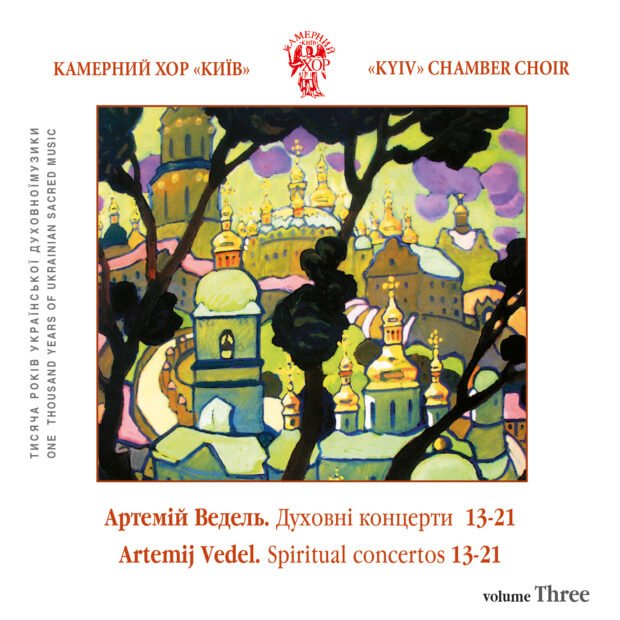
Artemij Vedel. Spiritual concertos 13-21
- Release: Kyiv Choir Productions
- Released: 2007
- Sound Engineer: Andrij Mokrytskij
- Cover: Reproduction painting by Yurij Chymych "Kyiv Monastery – Summer" (1990. Gouache)
Concerto No.21 "On the rivers of Babylon". Allegro maestoso
Artemij Vedel. Spiritual concertos 13-21
Concerto No.13 ” On the rivers of Babylon” (a-moll) (ps.136) 11:23
01. Lento. Moderato. Animato
02. Adagio. Moderato. Allergro maestoso
03. Adagio. Andante. Allegro
Concerto No.14 “Bend Your Ear towards us, O Lord” (ps.85) 7:25
04. Adagio. Allegro moderato
05. Andante. Allegro
Concerto No.15 “All-peaceful Glory” 6:09
(Mother of God dogmatic 1st tone)
06. Allegro
07. Adagio
08. Allegro
Concerto No.16 “Tell me Lord, about the end of my life” (ps.38) 4:35
09. Adagio, Allegro
10. Adagio. Allegro
Concerto No.17 “My deliverance, for why have You forsaken me” 6:41
(ps.41: 10)
11. Andante. Allegro
12. Adagio.Allegro
Concerto No.18 “The Day, O Lord Bishop of All Creation” 6:29
(Stikharion: Veneration of the Cross 8th tone)
13. Andante. Allegromoderato
14. Adagio. Allegro
Concerto No.19 “Hear daughter and See” (Es-dur) (ps.44: 11) 6:06
15. Andante. Allegro
16. Andante. Allegro
Concerto No.20 “With my voice Lord, I cry out to You” (ps.141) 8:16
17. Adagio. Moderato. Allegretto
18. Allegro. Moderato
19. Allegro
Concerto No.21 “On the rivers of Babylon” (c-moll) (ps.136) 9:50
20. Adagio sostenuto. Moderato
21. Gradatim allegro. Andante
22. Allegro maestoso
Total recording time 69:26
About the album
On this CD, the Kyiv Chamber Choir presents 9 sacred concertos (Nos. 13-21), which have not been preserved in autographs and come from various printed or manuscript collections (*Today the author’s attribution of some concertos has been revised. Concerto 21 is considered to belong to S. Dekhtyarev). Listening to these works, we find ourselves in the sphere of lyrical and dramatic images typical for Vedel, enjoying the plasticity of melodic lines, mastery of musical embodiment of the word, immediacy and beauty of ensemble singing, and richness of choral instrumentation.
The CD opens and ends with concertos on the text of Psalm 136, “On the Rivers of Babylon,” which are among the most beloved works of Orthodox music.
The idea of devotion to the homeland is embodied in them with extraordinary power. The concerts are characterized by a peculiar, nationally colored intonation, vivid imagery of the music, which consistently reveals the storyline and the change of psychological states – from crying, longing to angry protest. It is interesting to compare these works. Thus, within the common lyrical and dramatic imagery, the first is more chamber and lyrical, while the second is more monumental and dramatic. While the structure of the first concerto is less stable, dominated by small compositional units, with the exception of the more extended finale, the last concerto demonstrates the composer’s search for form on the way to forming a mature four-movement cycle, which suggests that this work was composed later.
An example of a four-movement cycle with a characteristic sequence of movements (slow – fast – slow – fast), albeit on a rather modest scale, is the lyrical Concerto No. 14 “Bow, O Lord, Thy Ear”. Addressing God with a sincere prayer, the composer finds the means to embody different feelings – these are the supplicating, sadly colored intonations of the first and third movements, the joyful exaltation of the second movement and the strong-willed determination of the finale.
The next two concertos, No. 16, “Tell us, O Lord, my demise” and No. 17, “My Advocate, because you have slain me,” are little-known works by Vedel, but both are vivid examples of the composer’s individual style. Written according to a typical four-movement scheme with a slow first movement, they are centers of primarily lyrical and dramatic images, embodied through a peculiar intonation that is nourished by Ukrainian song and romance melodies. However, the works differ in scale and, accordingly, in the degree of development of individual parts: the first is more concise, the second is more detailed, with figurative contrasts. An important expressive function is performed in both concertos by ensembles of different compositions (a penetrating female duet at the beginning of Concerto No. 17, a gloomy and mournful male trio from the third movement of Concerto No. 16, etc.)
The Concerto No. 18 “Today is the Lord of the Creatures” (the Concerto to the Cross, performed during Lent) impresses with its vivid imagery and vocal and choral perfection. In it, the composer reaches a high degree of imagery in telling the story of the Lord’s suffering. In the first movement, we seem to see the Cross in the rhetorical triplets of the soprano solo. The emotions of acute compassion and admiration for Jesus’ patience and sacrifice are expressed through the subjective sound of the ensembles, which play a leading role in movements I and III, giving the concert a particularly penetrating character.
The tutti and soli dialogues, as well as the emphasis on the upper voice soloing, emphasize the lyrical orientation of Concerto No. 19 “Hear, See, and Wait,” which is characterized by laconicism and intimacy. The work is based on individual lines of Psalm 44, the text of which is interpreted by the church as a prophecy about the dedication of the Virgin Mary to God’s service and is performed at the Christmas Eve service.
Concerto No. 20 “In My Voice” is characterized by classical restraint of emotions of a collected, concentrated, thoughtful, light-hearted, joyful or excitedly active nature. Using rather simple means, the composer creates vivid, visual images – a voice, a path, the worship of heaven, lightning, etc. Compared to many of Vedel’s concertos, the melody here, although quite expressive, does not receive an exceptional status: the concerto is an example of a harmonious combination of chordal texture with polyphonic, virtuosic plasticity of frequent textural changes.
Tetyana Husarchuk,
Doctor of Arts