
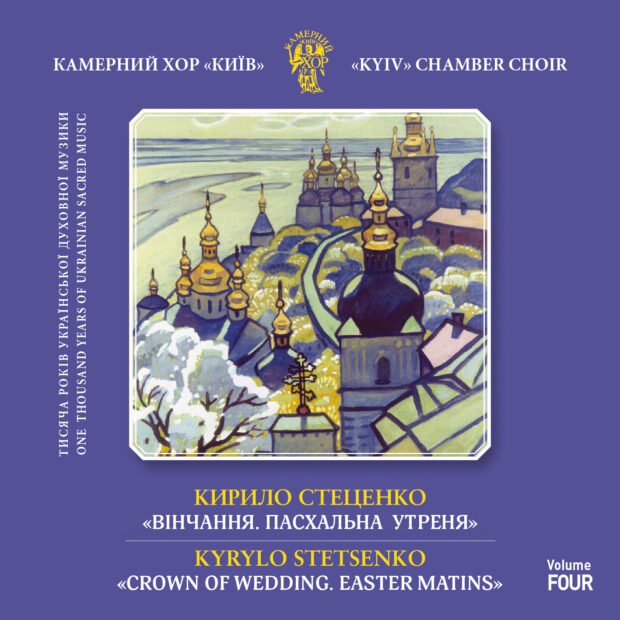
Kyrylo Stetsenko. Crown of Wedding. Easter Matins
- Release: Dotcom Recordings
- Released: 2010
Blessed are all
This Resurrection day
Your Resurrection, Lord Christ
KYRYLO STETSENKO
Crown of Wedding (1911)………………………41:11
1. Blessed are all ……………………………………..3:19
2. Great Ektenia ………………………………………6:00
3. Prokimen …………………………………………….2:31
4. Reading of the Epistle
Alleluia ……………………………………………….4:31
5. Reading of the Gospel …………………………..4:22
6. Triple Ektenia ………………………………………5:41
7. Our Father …………………………………………..4:32
8. Isaiah, rejoice ………………………………………2:43
9. Blessings …………………………………………….2:53
10. Dismissal …………………………………………….2:39
11. For many years ……………………………………1:58
Easter Matins (1920) …………………………….22:28
12. Your Resurrection, Lord Christ ……………..1:18
13. Tropar: Christ is risen …………………………..5:05
14. Song 1: This Resurrection day ………………2:26
15. Song 9: My heart glorifies…………………….1:56
16. The angel informed the Blessed Mary ……3:44
17. Bodily sleeping …………………………………….2:55
18. Easter Stychyras………………………………….3:00
19. Tropar: Christ is risen …………………………..2:00
Total time 63:43
About the album
The services “Wedding” and “Easter Matins” of K. Stetsenko are brought together in this recording as a result of a bold and original artistic plan – to re-establish these sacred rituals as a vibrant soulful national drama. This was inspired by the tenor of Ukrainian church ritual traditions, by the brilliant music of the composer and by his innovational attempts to introduce psalmodic traits into his last cycles (“Vespers” and “Requiem”). All this inspired the initiator of this artistic project – M. Hobdych – not only to assemble various works from the Paschal cycle, sometimes developing the available material, but also to blend the interpreted works with a “peopled” sonoral venue. The church service “Wedding” was written by K. Stetsenko in 1905 on the occasion of his own marriage, and later edited (in 1911) in Tyvrov. The musical style of the “Wedding” was obviously influenced by the personal emotions of the young author. The music abounds with triumphal happiness. Even in the chosen 127th psalm “Blessed are all…” (No. 1), he emphasizes not the reservations, but rather the promise of a fortunate future. Certain elements of concert setting for choir (imitational-polyphonic motion, tonal and textural contracts) are directed at achieving dynamic sonorities. In the “Prokimen” (No. 3) the desired concorded union is underlined by a dreamlike melody in parallel sixths and by the delicacy of higher voicing. The leading role in the service rests with the deacon and the priest. Today, specialists in the traditions of church psalmody are non-existent making the rediscovered authenticity of even greater value. During the ritual with the crowns, the psalmodic utterances of the deacon and priest are ethnically authentic, steeped in emotion and ethic. Pronouncedly, likewise sound the cantor’s sacred texts. All this makes for a feeling of high traditional warmth and goodnaturedness. The music of this episode incorporates a fully developed work “Alleluia” (No. 4) and “Ektenias” (responsories) (No. 6). The utterance of the sacred prayer “Our Father” (No. 7) occasions the syllabic setting of the text with minimal melismas. The choice of apt intonations sets apart the anaphoric beginnings of phrases. This is a moment of reflection into the rich sphere of thought and trust. “Isaiah, rejoice” (No. 8) presents the fulfillment of expectations. The souring flight of the melodic style, descriptive of emotional impulses, varies the flow of the music, similarly as in the dynamic mosaics for concerts. A minor exception is to be found in the song-like middle of the episode, which culminates with the glorification of the Holy Trinity. In the sections “Blessings” (No.9) and “Dismissal” (No. 10) the setting is in a markedly declamatory chordal-harmonic style. The final number of the “Wedding” is the choir “For many years” (No. 11) – a lapidary (gem-like) song, intonationally identifiable with the “Alleluia” with a similar alternation of three-voiced women’s and men’s choirs and an impressive six-voiced combination of these. The “Easter Matins” is compiled of eight of Stetsenko’s works – whose separate numbers were left unfinished – and the author did not succeed in unifying them into a single service. In this reconstruction, the Easter cycle attains its completion, an organic artistic integrity. Obviously, K. Stetsenko was interested in presenting musical images from various historic epochs. Therefore, he began the service with the Stychyr “Your Resurrection, Lord Christ” (No. 12) – which recalls the old ascetic monastic singing – a massive chordal six-part psalmody with assymetric phrasing and marked with a delicate pealing. Markedly closer to current musical styles is the Tropar “Christ is risen” (No. 13). Based on this featured melody, a dynamic and vivid antiphonal episode develops in which timbral contrasts comparing women’s and men’s choirs are combined with four declarations of the cantor, and culminates in the final full sonority of the mixed choir. The vivid picture of benevolent people celebrating Easter is established in the first song of the Canon “This Resurrection day, people, let us be enlightened” (No. 14). Light melodic motion, a variety of rhythmical accentuation, imitations, sonorous octave doublings and tender structural culminations bring to mind the lively Ukrainian custom (or even children’s) songs from the surrounding environment. Variations of the Tropars, and their further triple development of the imitational refrain, creates a substantial sphere of bright celebratory happiness – an important dominatingaspect of the cycle. The ninth song of the Canon “My heart glorifies” (No. 15) begins a series of lyric numbers, where polyphony predominates. They are unified by both the similarity of their intonational features, and their luminous sorrowful tenor. Especially full of emotion distinguishes itself “The angel informed the Blessed Mary” (No. 16), whose central section features the heroic image of the Irmos “Shine, shine”, and a lyrical plane. Full of mourning is the chant from Podilja “Bodily sleeping” (No. 17), where the pealing of bells takes on a plaintive sense. The sonorous celebratory pealing becomes most important in the “Easter Stychyras” (No. 18), which are sung in the old patterns with changeable meter-rhythms, similarly as in psalmodies. Its antiphonal development with contrasting choral groups imbues these Stychyras with variable timbral-acoustic colours, and promotes a dynamism of sound. The “Easter Matins” come to a close with embellishments of three variations of the Tropar “Christ is risen from the dead”, which at times frame off sections of the service, and also introduce new traits into its sonorities. A successful innovation of this closing feature shows itself to be the authenticceremonious renditions (with pealing bells) of “Christ is risen!” with the multitudes of faithful responding full of enthusiasm: “Truly He is risen!”. Reclaimed to life, K. Stetsenko’s works “Wedding” and “Easter Matins” have materially enriched today’s manifest store of sacred-choral literature both for church service and for concert performance.