
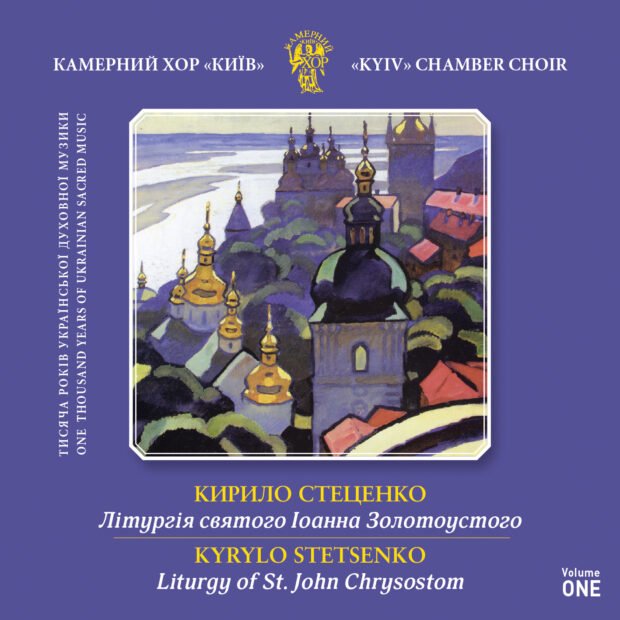
Kyrylo Stetsenko. Liturgy of St. John Chrysostom
- Release: Dotcom Recordings
- Released: 2009
- Sound Engineer: Andrij Mokrytskij
- Cover: Painting Reproduction by Yurij Chymych “The view at the Near and Far Caves. Summer” (Goache, 1991)
Our Father – Lord’s Prayer
Kyrylo Stetsenko. Liturgy of St. John Chrysostom
01. Litany of Peace
02. Bless the Lord, O my Soul
Short Litany
03. Praise the Lord, O my Soul
04. The Only Begotten Son
Short Litany
05. In Thy Kingdom
06. Come Let us Worship
07. O Holy God
08. New Testament Reading
Alleluia
09. Gospel Reading
10. Litany of Fervent Supplication
11. Cherubic Hymn
12. Father, Son and Holy Spirit
13. Creed
14. A Mercy of Peace We Hymn Thee
15. It is Meet and Right
16. Litany of Supplication
17. Our Father – Lord’s Prayer
18. One is Holy
19. Blessed is he who comes
in the Name of the Lord
20. We have seen the True Light
21. Let our mouth be filled with Your praise
22. Thanksgiving Litany
23. Blessed be the name of the Lord
24. Glory to the Father, and the Son
Total time…………………………………………………. 61:54
About the Album
Kyrylo Stetsenko – A composer of the highest order and talent, Kyrylo Stetsenko dedicated himself wholeheartedly to Ukrainian culture. In his short life he contributed impressive musical works, imbued with a personal spirituality, which live on even to this day. Stetsenko belongs to a pleiad of notable Ukrainian artists at the beginning of the XX century. Almost contemporaneous was the appearance in the musical life in Ukraine of: O. Koshyts’, M. Leontovych, S. Ljudkevych and J. Jatsynevych. This was a veritable assembly of great talents, which, having developed the creative traditions of Mykola Lysenko, raised the achievements of Ukrainian music to a high degree. Stetsenko was born on May 24, 1882, in the village of Kvitky, in the same county in which is found the birthplace of T. Shevchenko. Although his family was extremely poor, nevertheless all of the sons were sent to be educated. Kyrylo graduated from a theological school and seminary in Kyiv in 1903. While singing in the choir of the golden-domed St. Michael’s Monastery, one of the finest in Kyiv, he began composing sacred music. A church
reviewer found in his notebooks a number of contraventions of canons, and above all a “sinful emotionalism”. A radical change in Stetsenko’s orientation came with his entry into the capella of Lysenko, which in 1899 was preparing its third concert tour. Lysenko readily took notice of the young seminarian — Kyrylo was highly musical, had a brilliant memory and absolute pitch.
Soon Lysenko entrusted him with the job of assistant conductor. “There you see who will succeed me after my death” spoke the maestro to friends about Kyrylo. His friendship with Lysenko and the concert tours with his capella opened a new world for the young man, and he recognized his calling to art, culture and musical composition. Stetsenko’s creative output grew quickly; the youth combined composition and his studies in the musical school of Lysenko with conducting the seminarian choir and later, with his work with a folk choir. Recognizing Kyrylo’s artistic
work, the director of the religious-educational school, archpriest B. Lypkivs’kyj, invited him to teach singing and music there. This notable religious leader initiated the use of contemporary Ukrainian language into church services. However, after the subjugation of rising revolutionary change, when those who sided with open-minded thinkers began also to be persecuted, Stetsenko was not spared, but was mandated to an obscure village in the Don region. This was a tried and proven method — to isolate a creative personality from a friendly artistic milieu. In spite of all his efforts to return to Kyiv, Stetsenko spent close to 9 years in the province. An important achievement of the years 1907-1909 was his arrangement of 50 “Koliadky and Shchedrivky” (Carols and New Year’s songs) for mixed, treble and male choirs. This was a momentous undertaking, which showed the unique character of ritual calendar songs that preserved mythological qualities of the ancient world, the colour and magic of the rituals, and their mingling with the Christmas rites. Stetsenko’s discovery of the poetics of Ukrainian antiquity found a powerful resonance. It inspired O. Koshyts’ with the idea of making “stylized” theatrical Christmas concerts with the student choir of the Kyiv university. The unprecedented successes of these
talented presentations in Kyiv subsequently gave impetus to arrangements of ritual folk songs in the works of many composers. Stetsenko returned to public and creative life in Kyiv after the fall of Ukraine’s independent government, when the euphoria of revolutionary brotherhood of nations ended with the advance of the Bolshevik armies into Ukraine in January of 1918. In the midst of this political and social upheaval arose the enthusiasm and selfless effort of a citizenry dedicated to the idea of Ukrainian statehood. Among these we find also musicians, K. Stetsenko, M. Leontovych, J. Stepovyj, O. Koshyts, J. Jatsynevych, P. Demuts’kyj, who cultivated the principles of democratic education and culture, organized the institutions necessary for the fullest function and value of art, published manuals, and formed choirs. At the beginning of 1919, The Ukrainian Republican Capella, in which Stetsenko also participated, was formed with the purpose of demonstrating throughout the world the value of Ukrainian folk music – a feat that it accomplished with brilliant success under the direction of O. Koshyts. Especially important and central in Stetsenko’s efforts were the field of spiritual culture and the challenges of church nationalism. Here, fate once again associated him with the archpriest B. Lypkivs’kyj, the founder of the Pan-Ukrainian Orthodox Church Council, as well as the council for the translation of sacred texts into modern Ukrainian. The latter brought together eminent linguists, specialists in eastern and ancient languages including Old Slavonic. The astounding interweaving of Stetsenko’s spiritual energy and his creative production is evident in all the spheres of his activity at this time. In only a few years following the revolution, in spite of the difficult political climate, he composed twice the number of sacred works in comparison with all of his previous output. Talent and initiative ensured his role as cultural leader of his generation, which Lysenko had foretold. One of his greatest works of this time, written in 1918, was his “Panachyda (Memorial Service) in memoriam of M. Lysenko. The greatest authority in this field, O. Koshyts, considered Stetsenko’s sacred music full of genius the Panachyda being his best. The practice of regular services in the
Ukrainianized parishes and churches in Kyiv raised a need for new musical repertoire for the whole yearly cycle. In response, Stetsenko composed the Liturgy of Basil the Great, the Liturgy for choir and congregational singing (1920), Vespers (1921) and many other sacred hymns and songs to various church services. At the same time, Stetsenko was involved in fruitful organizational-cultural work in the cooperative centre of “Dnipro-sojuz”. Its musical printing press began printing works of Ukrainian composers and musical treatises and a fund was established for a musical library. Two large touring capellas were organized, whose purpose it was to give concerts throughout Ukraine. The first capella was conducted by N. Horodovenko; the second
by K. Stetsenko. In addition to these concerts, which consisted mainly of new Ukrainian music, performances of sacred works (Vespers, Liturgy of J. Chrysostom) were also given. Customarily, the capellas’ members presented local choirs with new music, thereby stimulating its performance and giving impetus to choral activity in general. Returning to Kyiv from a concert tour, Stetsenko learned that “Dniprosojuz” had been reorganized and the musicalchoral section was closed down. Disheartened, Stetsenko felt that his achievements had been ruined and in a letter to Leontovych wrote: “Having no work and for the sake of some bread I even accepted a parish on the outskirts of Fastov”. He divided his time between the cities of Vepryk and Kyiv, lecturing on choral literature in the Musico-Dramatic Institute and working in the Pan-Ukrainian Orthodox Church Council. Preparations were underway in Kyiv for a historic conference of the Pan-Ukrainian Orthodox Church in October 1921, which resulted in the archaeo-christian ordination of its hierarchical Episcopate, choosing Basil Lypkivs’kyj for its metropolitan and proclaiming the validity of the autocephalicism of the Ukrainian Orthodox Church. On this occasion archpriest K. Stetsenko had several functions: priest, conductor and author of works that were performed in the services during this conference. In the spring of 1922, when epidemics were rampant in the country, Stetsenko contracted typhus. Weakened by hard work and deficiencies, the composer did not recover from the debilitating illness, and on April 29 his heart stopped beating. On his workbench he left unfinished his opera “Iphigenia in Tauride”, music to “Hajdamaky”, a second edition of his “Panachyda, a translation of the text of his Liturgy of J. Chrysostom, and sketches of recently begun works.
* * *
K. Stetsenko’s large cyclical works, written for church services, are performed today both in church and in concert. Recordings and concert performances readily offer the opportunity to appreciate the organic wholeness of the composer’s artistic conception, the individuality of its author’s interpretation, and his achievement of a unique genetic code of genuine national prayer – not only in melodic-intonational styles, but also in the manners of textual exposition and setting. On this disc special consideration was given to the expression of choral proclamations and to the observance of traditional cantoral and priests’ chants that interpolate and unify the music. The second Liturgy of John Chrysostom (“Zolotoustyj”) was written in Tyvrov in 1910; it is characterized by a lyrical conception of this musical cycle. This is evident already in the First Antiphon “Bless the Lord, my soul”, where the plasticity of the melodic line is combined with a highly prayerful quality. This Antiphon is among the most popular of Stetsenko’s choral works and it serves as a worthy model of Stetsenko’s creative approach. In the whole liturgical cycle it not only establishes Stetsenko’s lyrical concept, but also becomes a source of thematic intonational material. Bringing in the themes of the First Antiphon (after the Small Ektenia) into the Second, “Praise the Lord, my soul”, the composer reintroduces its music almost without change, but establishes different contexts — reservation in the setting “Set not your hope in Kings”
and festive prediction in “Enthroned shall be the Lord”. The countervailing of contrasting pictures is a factor of dynamism and drama in the Liturgy’s progress. In the context of these contrasts the composer characterizes his “Only-begotten Son” offering a bright pastel episode wherein the composer combines a conversational manner in the exposition of the text with cantabile intonations, colorized with soft harmonies, imitational cross-currents and deep organ-like points. This keenly bright episode becomes a worthy contrast to the Third Antiphon “In Your Kingdom” where the dark tonal spectrum, the low register of the women’s voices, and the preponderance of declamatory sorrowful intonations all underline tragedy. “Holy God” is reminiscent of folk melodies; it sounds self-sufficient in the 3-part women’s choir, the same with the tenor counterpoint, and in the canonic imitation of the women’s choir by the men’s. An important substantive factor in the rounding-off of the Liturgy’s first section (after the reading of the Apostle) is the deeply-divine song “Alleluia” – a chant reminiscent of magic sacred intonations and
hymns from ancient times. Sung three times it gathers new vigour with every repetition. The elasticity and resonance in the song of praise “Praise to You, o Lord” festively ends the Liturgy’s first part. In the second part of the service, after the dynamic “Triple Ektenia” comes the contrasting lyrical quality of “Song of the Cherubim” which feels like a moment of mystic and dreamy envisionment. The freely flowing motion of the melodic lines creates a diaphanous background to the delicate chantlike motif of the soprano, incorporating the unearthly tenderness of heavenly singing. “I believe” is the most substantive part of the Liturgy, which derives from one of the main Christian dogmas. In order to clearly articulate the text, the composer used various techniques of choral declamation, which made it possible for him to create a monumental, culminating structure, and to disclose the mass of information and sacred text of the dogma. “Our Father” is the central episode in the Liturgy. The 6-voice choral sonority on a tonic pedal, in which the melodic motion begins from the highest notes, softly embellishes the colorful harmonies and readily sets a special mood – one of faith and acceptance. To achieve this, Stetsenko chooses very simple means; one-voice fragments and polyphonic developments are the only departures from the maximally clearly articulated declamatory choral intonation of the text of the Lord’s Prayer, performed with the highest piety. The subsequent selections illustrate spheres of the confirmation of life. There is here, however, a mournful lyrical song of thanks to the Lord “Let our lips be full of praise”, where the chant gets a characteristic dramatic development in the central dramatic structure. The cycle is closed by “Blessed be the Lord’s name” and “Glory be to God”. As a whole Stetsenko’s composition Liturgy of John Chrysostom is a monumental cycle bearing on great dramatic conflicts, created with high artistic power. Recreating the artistic conception of a grandiose drama, the composer operated with diverse means and a variety of techniques of writing to build a dynamic dramaturgy, which aided the development of the artistic idea in a variety of aspects. The influence of Stetsenko’s work is realized in the incorporation of new criteria and creative principles incorporated by the post-Lysenko generation of Ukrainian composers.
Lju Parchomenko
Doctor of Arts, Professor
English version by Zenoby Lawryshyn