
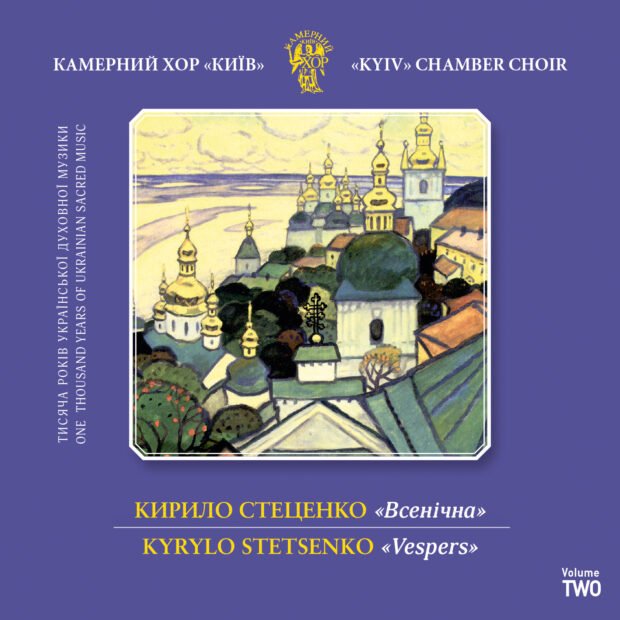
Kyrylo Stetsenko. Vespers
- Release: Dotcom Recordings
- Released: 2009
Rejoice, O Virgin
KYRYLO STETSENKO «Vespers»
Vespers
01. Come, let us worship……………………………..01:25
02. Bless my soul, O Lord …………………………..03:50
03. Blessed is the man ……………………………….02:49
04. O serene light……………………………………….02:38
05. The Lord reigns ……………………………………02:11
06. Today you dismiss your servant ……………02:05
07. Rejoice, O Virgin ………………………………….02:38
0 8. Blessed be the name of the Lord …………….01:10
Matins
09. Small Doxology…………………………………….01:41
10. Praise the name of the Lord…………………..02:29
11. Blessed art Thou, O Lord……………………….02:55
12. From my youth……………………………………..01:54
13. All that breathes……………………………………01:06
14. I have seen the Resurrection of the Lord…01:45
15. By the prayers of the apostles ……………….02:34
16. My soul doth magnify the Lord………………04:13
17. Praise the Lord, our God……………………….00:44
18. Most blessed be it…………………………………01:35
19. Great Doxology…………………………………….08:42
20. Troparion “Today salvation has come”……01:31
21. Troparion “Resurrected from the grave”…02:15
22. Lord, strengthen us……………………………….02:43
23. Victorious art Thou, O Mother of God…….01:20
Total time………………………………… 56:27
About the album
“Not many works of Orthodox church music can compare in richness and beauty with the works of K. Stetsenko. His ‘Vespers’ (Vsenichna) is a complex interpretation of a liturgico-elegiac Ukrainian evening, filled with devout inspiration and beauty; a symphony of musical hues of sunset and the evening world.” (Vasyl Zavitnevych).
Stetsenko’s large cyclical works, written for church services, are performed today in concerts both as cycles and in excerpts. Concert performances and recordings readily offer the opportunity to appreciate the organic wholeness of the composer’s artistic conception, the individuality of its author’s interpretation, and his achievement of a unique genetic code of genuine national prayer, not only in melodic-intonation styles, but also in the manner of textual exposition and setting. On this disc, special consideration was given to the expression of choral proclamations and to the observance of traditional cantoral and psalmodic chants that interpolate and unify the music. “Vespers” (Vsenichna) belongs to the services introduced into the church ritual around the 15th century. Held on the eve of important feasts, it prepares the faithful for the celebratory services depicting the relationship between the past epoch of the Old and New Testaments. Stetsenko worked on the Ukrainian musical version of this service during the confessional conflicts between the Ukrainian and Russian churches that preceded the Pan-Ukrainian Orthodox Church Conference in 1921. The extensive material of traditional liturgical chants that he collected was of large import for the Autocephalic Ukrainian church, which was in need of research into national rituals. This was a valuable achievement of the creative endeavour of many generations of priests and artists. Working on the old chants, Stetsenko underlined their salient elements, introduced variety into their characteristic melodic-harmonic expressions, both phrases and sentences, and emphasized them in repetitions and antiphonal expositions. After the traditional “Come, let us worship” begins a distinct and developed episode of the Vespers — the antiphon “Bless my soul, O Lord”. The providential character of the images in this psalm intrigued the composer. It is, perhaps, for this reason that new aspects are accentuated in his interpretation. There are, in the music, two emotional spheres: a personal inspiration from the acts of our Lord, and, in addition, a hope in the miracle of social renewal. In “Blessed is the man”, a chant from old ritual traditions, the composer unites a syllabic intonation of the text with the chants. The refrains incorporate characteristic cadence formulas, and this becomes stylistic for the Vespers, as well as a key for its modal variety. The plaintive chant “O serene light” develops as a transparent miniature of several developmental phases and a relieved culmination. A rather large part of the music consists of arrangements of chants from the Kyivan-Pechers’ka Lavra tradition – among these, “Today you dismiss your servant”. Carefully retaining the character of its model — the variability of the meter-rhythm, the manner of reciting the phrases — the composer unexpectedly introduces canonic imitation in its culmination. A similar feature appears in the culmination of “Rejoice, O Virgin” (Ave Maria). These polyphonic techniques broaden the palette of contrast in the stylistics of these short chants, and at the same time become unifying elements in the entirety of the Vespers service and the beginning of the matins – “Small Doxology” (small glorification). A large effective contrast is introduced into the Matins by “Praise the name of the Lord”. The stylistic model for this work is to be found in Ukrainian steppe songs with their abundantly flowing melodies, fostered by an unimpeded spiritual impetus. An organic link, that unified the strophes and introduced this seemingly elemental emotionalism into the ritual service, was the final phrase of the Alleluia — a leitmotif cadence-emblem, formulated already in the ending of “Blessed is the man”. For the arrangements of the chants from the Kyivan-Pechers’ka Lavra tradition, “Blessed art Thou, O Lord” as also the subsequent “I have seen the Resurrection of the Lord” and “By the prayers of the apostles”, we have a characteristically careful reconstruction of the modal spheres of the chants, a textural unification of the monosyllabic recitations of the choir with adapted phrasings. The model for the chant “From my youth” was the repentant verses and psalms. Its emotional music is eminently singable and full of sharpened harmonic sonority. The “Great Doxology” (great glorification) is imbued with a grandiose construction: the author not only reintroduces the vivid musical material of the “Vespers”, combining it with new interpolations, but also introduces new episodes of deep sorrow and repentance. The tropars of the Lavran chants “Today salvation has come” and “Resurrected from the grave” are lyrically and intonationally related to “Today you dismiss your servant” and “O serene light”. They are perceived as forming explicit contextual arcs. The chants “Lord, strengthen us” and “Victorious art Thou, O Mother of God” create a sphere of luminous inspiration, spiritual renewal, incorporated with stylistic traits and intonational-thematic musical commonalities. K. Stetsenko’s “Vespers” distinguishes itself among all of the millennial achievements of the national spiritual culture. Written in an original Ukrainian musical language, imbued with a deep religiosity, it belongs among the great treasures of liturgical art.