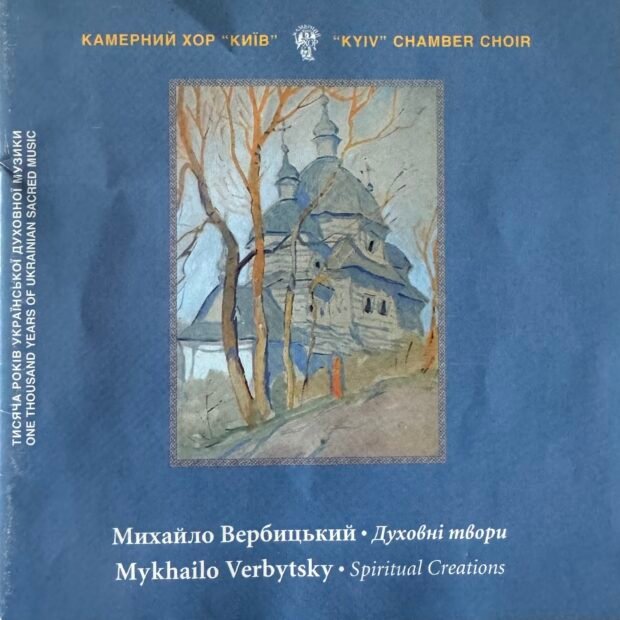
Mykhailo Verbytskyi. Spiritual Creations
- Release: Kyiv Choir Productions
- Released: 2004
- Sound Engineer: Andrij Mokrytskij
- Cover: Painted reproduction by Yurij Chymych "Church of the Holy Sririt" (Lviv oblast, village of Potelych, 1971, gouache)
Alleluia
O Holy God
Ukrainian National Anthem
Mykhailo Verbytskyi. Spiritual creations
Liturgy 47:05
Only begotten Son. Short Litany
O Holy God
Alleluia
Holy Spirit
The Litany of the Lord
Cherubic Hymn
The Father and the Son
The Creed
The Mercy of Peace. To Thee we sing
It is Meet and Right
Our Father
Only One is Holy
Praise
Let it be fulfilled
Hallowed be the name of the Lord
Glory to the Father and to the Son
The angel will lead the way (Easter concert) 4:47
Christ is risen (male choir) 2:11
Christ is risen (women’s choir) 1:32
Christ is risen (mixed choir) 1:15
National anthem of Ukraine 2:46
Duration: 59:38
About the album
“Singing should be smoothed out, it needs purification and, like a newborn child, growth and strength…” M. Verbytskyi
The creative personality of Mykhailo Verbytskyi (1815-1870) is a vivid example of an artistic personality of the Romantic era with all the very diverse features of the creative nature characteristic of this time, which was formed in the complex and contradictory socio-historical and national-cultural processes of Western Ukraine during the Austro-Hungarian Empire. A selfless and tireless worker in the field of Ukrainian musical culture, he became one of the few Galician intellectuals who defined the main directions of professional musical art and laid solid foundations for its development.
During a short period of study (1828-1833) at the Przemysl Institutum cantorum et magistorurum (a Greek Catholic singing school founded by Bishop John Snihursky in 1818) and privately with the Czech composer-conductor Alois Nanke, he not only mastered the basics of musical literacy and counterpoint, but also thoroughly studied classical and romantic music based on the works of Viennese classics, D. Bortnyansky, M. Berezovsky, and F. Schubert.
The composer’s life did not appear to be easy and was full of many unforeseen conflicts. From 1834, Verbytskyi studied at the Lviv Theological Seminary, from which he was repeatedly expelled due to his free behavior or his too progressive views. It is worth noting that, despite his long attempts to obtain the priesthood, Verbytskyi led an active, romantic bohemian secular life with his “companion,” the guitar. He graduated from the seminary in 1850, receiving his long-awaited ordination as a priest. All the years between his studies at the seminary were devoted to finding a permanent job (he was a chaplain of the Lviv Stavropegia, a music and guitar teacher, and even a secretary of the office of the Bishop of Przemyśl).
This period is characterized by great creative intensity. The composer’s important achievements are his church compositions, including “Liturgy” for mixed choir and two Catholic masses. The composer’s oeuvre also includes the first examples of music for a large orchestra, which, according to the author’s definition, are “symphonies” or rather one-part overtures, of which Verbytskyi has more than ten. Another significant achievement of the composer is the music for the first Ukrainian theater performances.
In 1850, the composer began a period of wandering around rural parishes. Only in 1856 did he receive a permanent parish in the village of Mlynky in the Yavoriv region, where he lived for the rest of his short life. Here, having returned to active work, he wrote articles on the problems of music education and creativity. He also continued to write spiritual compositions intensively, in particular, in the last year of his life he wrote “O Cherubim”, “Holy God”, and “I will sing to You”, full of deep sincerity and prayerfulness.
The versatile musical activity of Mykhailo Verbytskyi is a bright page of our artistic heritage. Having developed his own original style, oriented to the early romantic traditions, M. Verbytskyi soon became a prominent representative of the Przemyśl school of composers, which in the mid-nineteenth century contributed most to the revival and further development of professional traditions in the field of church music, as well as to the emergence and formation of new genres of secular music. Verbytsky was a follower of Bortnyansky in the field of church music, the creator of the first symphonic compositions, music for theater, choral music, and solos. It was Verbytskyi who, with his great talent, managed to become the deepest expression of national struggles and thoughts, which found their highest artistic embodiment in the patriotic song to the words of Pavlo Chubynskyi “Ukraine Has Not Yet Died.” Composed in 1863, this song quickly gained popularity in Galicia, and since 1991, when Ukraine gained independence, it has been its national anthem.
Mykhailo Verbytskyi’s religious works occupy a leading place in his rich multi-genre creative heritage. These sacred miniatures, full of sincere prayer and extraordinary musicality, have stood the test of time and are still performed today, both during traditional services and in concert. Most of his spiritual compositions (there are more than forty in total) are united by a single liturgical cycle, where a number of parts have two or even three variants. It is worth noting that the composition of the choir (male or mixed) was determined by the performance capabilities of the seminary, stavropegia, or diocese, so the composer often revised his works depending on this.
Mykhailo Verbytskyi’s church music, due to its spiritual and professional qualities, occupied an important place in the process of formation of Ukrainian music in the period between Bortnyansky and the founders of the new compositional school – Mykola Lysenko, Stanislav Liudkevych, Kyrylo Stetsenko, and Mykola Leontovych.
Volodymyr Syvokhyp
Laureate of the Mykola Lysenko Prize