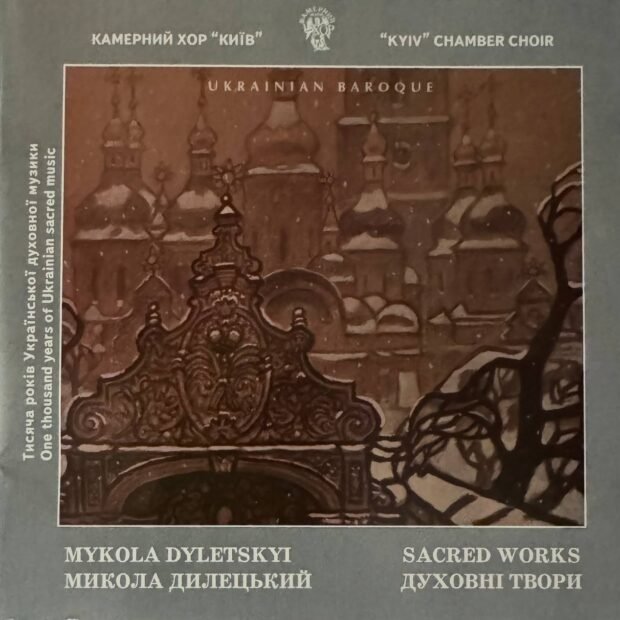
Mykola Dyletskyi. Sacred Works Disc 1
- Release: Kyiv Choir Productions
- Released: 2003
- Cover: Painting Reproduction by Yurij Chymych "The Baroque Fronton. Zborovskyi's Gate" (Gouache, 1999)
- Sound Engineer : Andrij Mokrytskyj
O come let us Worship
Mykola Dyletskyi Sacred Works
Disc 1
Divine Liturgy for four voices 32:47
(edited by M.Hobdych)
- Only Begotten Son
Short Litany - O come let us Worship
- O Holy God: The Trisagion Hymn
- Alleluia
- Litany of Fervent Supplication
- Cherubic Hymn
- A Mercy of Peace
To Thee we sing - It is Truly Meet and Right
- Only One is Holy
- Praise the Lord from on High
- We have seen the True light
- Glory to the Father and the Only Begotten Son
- We praise your image 5:04
(edited by M.Hobdych) - Confess to the Lord and Praise 1:55
(paired concert)
Divine Liturgy: Kyivan Chant 25:54 - Only Begotten Son
Short Litany - O come let us Worship
- O Holy God: The Trisagion Hymn
- Alleluia
- Litany of Fervent Supplication
- Cherubic Hymn
- A Mercy of Peace To Thee we sing
- It is Truly Meet and Right
- Glory to the Father and the Only Begotten Son
Total time: 65:49
About the Album
Mykola Dyletskyi was the most prominent figure in the Slavic musical world of the second half of the seventeenth century. His work largely determined the development of music in the territory that encompassed Ukraine, Belarus, and Russia, and laid the foundation for the formation of the modern compositional school.
Not much is known about Dyletsky as a person, and even the dates of his life are questionable: 1650? – 1723. There is only a mention of his origin: “a resident of the city of Kyiv”. His stay in Vilna (now Vilnius), where he received a brilliant education at the Jesuit Academy and was awarded the title of academician, is documented.
Since the late 1970s, Dyletskyi has been living in Moscow, a member of the intellectual elite of the time, which united prominent representatives of the new artistic intelligentsia. Dyletsky is the author of the first theoretical treatise in Eastern Europe, Grammar of Music (or Musik), which exists in several editions and language versions. Drawing on the European scientific thought of the time, Dyletsky outlined the basics of music theory, composition, aesthetics, and rhetoric, and laid the theoretical foundation for a new style, the so-called “partes” style, which replaced the centuries-long dominance of church monody.
This baroque art was established in Ukraine in the early seventeenth century, and from the second half of the seventeenth century Ukrainian masters transferred it to Moscow.
Today, Dyletsky’s well-known oeuvre, discovered mainly in the 1970s, is represented by multi-choral eight-voice compositions of the European model, both in the traditions of the Roman and Polish schools, and by more chamber four-voice works related to the Italian and possibly German spiritual motet and madrigale spirituale.
A true master, a man of broad views, Dyletsky actively mastered European musical technique, which he sought to adapt to the requirements of a new environment and different intonational vocabulary. According to the treatise, its author was equally familiar with the music of everyday life, the traditions of monodic singing, simpler forms of polyphony based on it, and the achievements of European composers, from Josquin and Palestrina to Schütz. All of this created a solid foundation for the innovation of the author of the Resurrection Canon.
Mykola Dyletskyi’s works, even with the limited number of them known today, reveal a richness and diversity of style. As well as the entire array of newly discovered partes concertos, they testify to their full compliance with the cultural context of the time and the extraordinary creative upsurge in Ukrainian music of the seventeenth century. It is no coincidence that the figure of Dyletsky and his partes works forced not only to revise the concepts of the history of Ukrainian music, but also to rethink the panorama of European art.
N.O. Herasymova-Persydska, PhD