
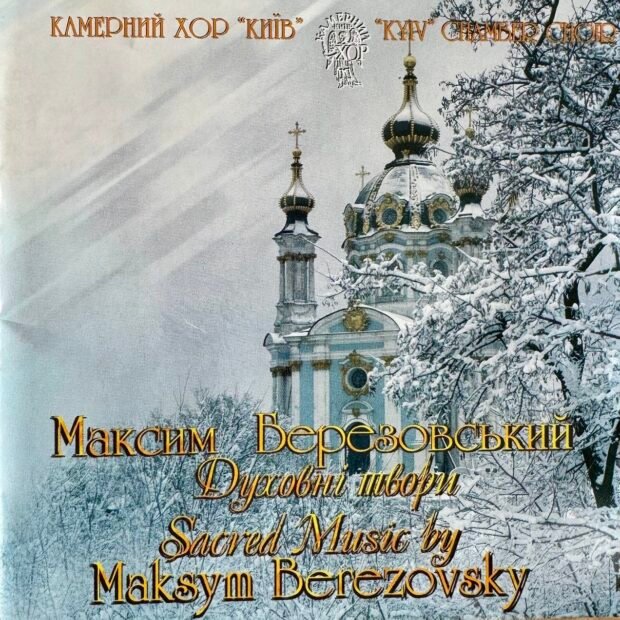
Sacred Music by Maksym Berezovsky
- Release: Kyiv Choir Productions
- Released: 2001
- Cover: St. Andrew's Church (Baroque style, XVIII century, architect B. Rastrelli)
- Sound Engineer: Andrij Mokrytskyi
O Holy GOD
Praise God in the highest №2
Maksym Berezovsky. Sacred works
Divine Liturgy
- Only Begotten Son
Short Litany - Come Let us Worship
- O Holy God: The Trisagion Hymn
- Cherubic Hymn
- Litany of Fervent Supplication
- The Creed
- The Mercy of Peace
To Thea we sing - It is Truly Meet and Right
- The Lord’s Prayer
- Glory to the Father
Communion anthems - Praise God in the highest №1
- Praise God in the highest №2
- Praise God in the highest №3
- Anoint us, O Lord
- Rejoice, O you righteous
- Blessed are those who are chosen
Choral concertos
- God stands in the congregation of the mighty (Ps. 81)
- The Lord reigns (Ps. 92)
- Do not turn away from me, as I age (Ps. 70)
About the album
Maksym Berezovsky was the most prominent Ukrainian composer of the eighteenth century, the creator of the national classicist choral concert, whose work first embodied the leading genres of Western European music: opera, chamber instrumental works, and new church choral forms.
There are only oral traditions about Berezovsky’s origins and education, which claim that the future composer came from the “Cossacks of Hlukhiv” in Eastern Ukraine (his father was Sozont) and studied at the famous Kyiv-Mohyla Academy. M. Berezovsky had an outstanding voice, because as early as 1758 he sang in a chapel in Oranienbaum (near St. Petersburg), and in 1762 he became an artist of the St. Petersburg court “Italian Chapel.” In the 60s, under the influence of sacred concertos composed by Italian court composers, M. Berezovsky also wrote choral concertos in a new “Italian style”. These compositions were recognized by the court. In the late 60s, Berezovsky was sent to Italy to study in Bologna with the famous Padre Martini, who praised his student’s musical talent. In May 1771, Berezovsky successfully passed an exam at the Bologna Philharmonic Academy and was awarded the title of “academician-composer.” Berezovsky’s tragedy began when he returned to St. Petersburg in 1773. The several years the composer spent looking for work led to a terrible depression that led to his tragic death in March 1777. “And as there is nothing left after his death and nothing to bury his body with…” reads a note from the director of the court theaters about the death of the most prominent composer of Eastern Europe, the Bolognese academician of music Maxim Berezovsky.
Berezovsky’s work is quite diverse: choral concertos, cantatas, liturgical chants, opera, and chamber instrumental works. However, most of these compositions have not been found. But even those that have been found impress with their exceptional originality, vividness of imagery, and power of expression. During his short life, Berezovsky went a long way from Baroque to classicism, and his genre range extends from opera-seria (“Demoofonte”) to chamber instrumental music (sonata for violin and cembalo). However, Berezovsky is most famous for his choral works. It was in church choirs and choral concerts that Berezovsky’s powerful talent was fully revealed. The lyrical and dramatic type of Berezovsky’s talent allowed him to create a number of liturgical works in which a bright, pure religious mood is conveyed in the sublime manner of joyful religious ecstasy, reminiscent of the light-filled images of D. Palestrina, and the expressive melody, in which the intonations of Ukrainian songs are felt, captivates the soul with the power and depth of feelings. Berezovsky expresses the sharpness of dramatic conflicts with such titanic force that his work is on a par with the works of the most significant masters of his time. He was the first to raise the theme of the suffering of the creator to the level of the philosophical idea of the struggle between good and evil. The power of the expression of this idea elevates Berezovsky’s compositions to the level of such masterpieces of world musical culture as the late works of W. Mozart and the symphonies of L. Beethoven.
Mstуslav Yurchenko,
Doctor of Arts