
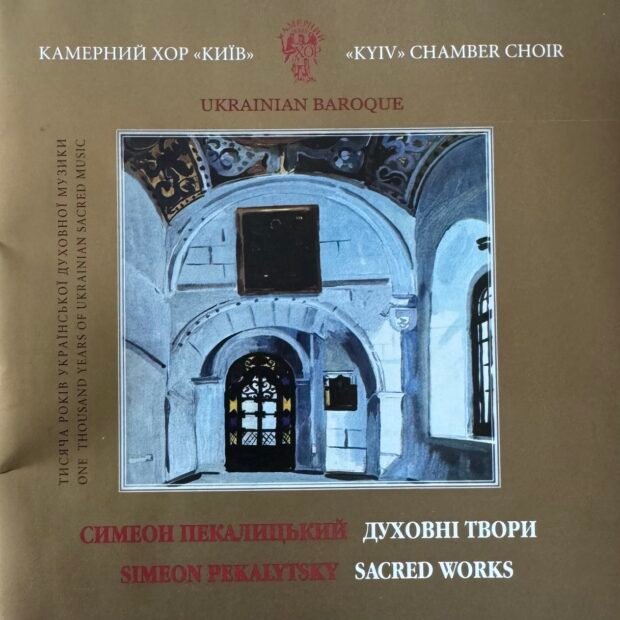
Symeon Pekalytskyi. Sacred Works
- Release: Kyiv Choir Productions
- Released: 2008
- Cover : Painting Reproduction by Yurij Chymych “Lviv. Interior of the Chapel of the Three Saints” (Watercolor, gouache, 1966)
- Sound Engineer: Andrij Mokrytskyj
Cherubic Hymn
Symeon Pekalytsky
Liturgy 24:14
- Only Begotten Son
Small Litany - Come let us worship
- Holy God – Trisagion Hymn
- Reading of the Apostle
Alleluia - Litany of Fervent Supplication
- Cherubic Hymn
- Mercy and Peace
We Praise You - Hymn of the Holy Mother of God
- Glory to the Father and to the Son
- Sacred Concert
“Your Blessed Spirit“ 3:36
About the Album
Symeon Pekalytskyi (17th century) was a prominent Ukrainian composer, choral conductor, singer, and music teacher.
It is not yet known where the composer was brought up and where he received his musical education. The first mention of Pekalytsky dates back to the 60s, when he became the regent of the chapel of Chernihiv Archbishop Lazar Baranovych (1620-1693). Lazar Baranovych, a well-known church, political, and literary figure in Ukraine, was a supporter of the unification of the Ukrainian, Russian, and Polish peoples against common enemies, the Tatars and Turks. However, he defended the independence of the Ukrainian Church from the jurisdiction of the Moscow Patriarch. Baranovych brought church singing to such a professional level that the best singers were invited to Moscow. Simeon Pekalytsky achieved this level of choral training.
Together with his patron L. Baranovych, in October 1666 Pekalytskyi arrived in Moscow with a choir of eight singers and stayed there for about a year.
In 1667 (immediately after Moscow), Pekalytskyi moved to Lviv to serve under Yosyp Shumlianskyi. He served in the Univ and Slovinsky monasteries, where he taught singing and music theory.
On the recommendation of Archbishop L. Baranovych, on 8.03.1673, Pekalitsky again went to Moscow, where he headed the Court Chapel.
Pekalytskyi’s activities over the next fifteen years have not yet been clarified.
It is known that in the 1980s Pekalytskyi led a local choir in Novhorod-Siverskyi. There is also information that a letter from the Little Russian Order to Hetman Ivan Mazepa dated 6.02.1688 refers to the transfer to Moscow of “Novhorod-Siverskyi priest Simeon Pekalytskyi with his wife and children.” It is not known for certain what work he did there. There is information that Pekalitsky was a priest of the Sretensky Cathedral of the Moscow Kremlin, which was intended for the royal children to serve.
“Liturgy” and the concert ‘Thy Good Spirit’ (a reconstruction of the scores by V. Protopopov) are the only two works by the prominent Ukrainian composer that have been found to date. However, there is information that at the time of the census of the Lviv Brotherhood’s sheet music in 1697, there were four “Divine Liturgies” by S. Pekalytsky for 8 voices.
I hope that the next generations of the Ukrainian school of musicology will once again revisit the archives of state museums, libraries, monasteries, and churches that are already open to the public. That the time is not far off when Ukrainian culture will be presented to its own and other peoples in full. The thousand-year history of Ukrainian spiritual culture is an organic part of world culture.
The last years of Simeon Pekalytsky’s life are still unclear.
Mykola Hobdych