
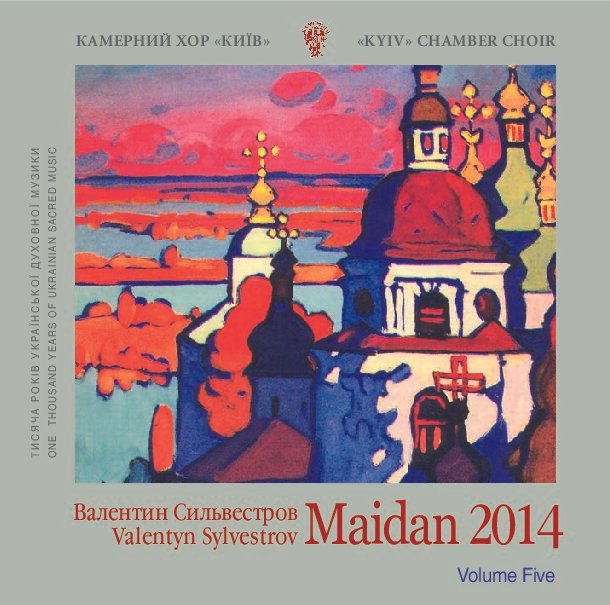
Valentyn Sylvestrov. Maidan 2014
- Release: Kyiv Choir Productions
- Released: 2017
- Sound Engineer: Andrij Mokrytskij
- Cover: Reproduction painting by Yurij Chymych "Vydubychi Monastery – Red autumn" (1990. Gouache)
National Anthem
And Glory, Mountains Blue, to You
Maidan 2014 (cycle of cycles)
Cycle І
1. National Anthem (words by P.Chubynsky)
2. Glory likewise to you, ye mountains blue
3. O Lord, grant this to your servant to rest
Cycle ІІ
4. National Anthem (words by P.Chubynsky)
5. Lacrimosa
6. Holy is God
Cycle ІІІ
7. Natioanal Anthem (words by P.Chubynsky)
8. The Lord’s Prayer
9. Requiem aeternam
10. Agnus Dei
Cycle ІV
11. National Anthem (words by P.Chubynsky)
12. Elegy (no words)
13. Prayer for Ukraine (text anonym)
14. National Anthem (words by P.Chubynsky)
15. Lullaby (words Byelorussian folk)
Four songs (verses by T.Shevchenko) (2014)
16. Roars and groans the broad Dnipro
17. There is destiny in this world
18. A cherry grove
19. My Legacy
Dyptych (verses by T.Shevchenko) (2016)
20. To little Marian
21. Psalm (Roars and groans the broad Dnipro)
Tryptych (verses by T.Shevchenko) (2015)
22. Oh, twilight splendour, twilight quiet
23. Come to your senses
24. Alleluia
Total playing time 76:33
About the Album
«…If I was asked to come up with the name of a contemporary composer, the first name I would come up with would be Sylvestrov Valentyn – without a doubt the most interesting composer of our times, even if most (people) will grasp this much later…» Arvo Pärt
It is extremely difficult to find words to characterize the music of Valentyn Sylvestrov. Difficult because no words can convey the subtle content of Sylvestov’s works, for they are born, exist and develop exclusively in an intonational, inexpressible sphere. The glimmering sensations, smooth associations and the numerous varied overtones of the music, once named and expressed, become real, and so lose their unique and unrepeatable multidimensionality.
One can approach Sylvestrov from many angles: one can discuss his creative output, or his life achievements. Valentyn Sylvestrov (born 30 August, 1937 in Kyiv) is a famous Ukrainian composer, and merited national artist of Ukraine (1989). Among his many other honours are the International Kusevytsky Composition Prize (Washington, 1967), the International composers’ competition «Gaudeamus» Prize (Holland, 1970), and the T. H. Shevchenko National Ukrainian Prize (1995). V. Sylvestrov graduated from the Kyiv conservatory in 1964, having studied composition under B. M. Liatoshynsky. One can also talk about the genre priorities of the composer. Here, of course, instrumental music dominates — from symphonies and vocal-symphonic compositions to chamber ensembles and piano pieces, although the essential part of the creative work is chamber vocal lyrics. While for the longest time instrumental music dominated his output: symphonies and vocal symphonic works, chamber, and piano music, a great portion of his musical output is comprised of vocal and lyrical chamber music. However, all the mentioned (and not mentioned) aspects of Sylvestrov’s music reveal only the external layer of his music.
The essence of his music lies in something else, and can only be experienced directly when one is immersed in the intonational body of the compositions. One can then understand it. The best speaker for it is the composer himself, who in great detail, depth, and accuracy explains his position. One can finally understand it by combining intense listening with calm reflection. Valentyn Sylvestrov begins his creative life by writing instrumental music. Piano compositions, instrumental chamber ensembles, and symphonic compositions form the bulk of his output in the 60’s and 70’s. He tackled choral music later.
«I never thought that I would be writing choral music. The piano — that was my destiny…». It is important that we to pay close attention to these words of the composer. For in his choral music we hear echoes of romantic piano phrasing (idioms), and the whole choral texture appears before us as an instrumental composition. Instrumental, yet in a strange and inexplicable way it merges with a lyrical cantilena chant, either a solo vocal chant, a chant expressing joy, or just a plainsong: «…in essence, these are piano works, except that the singers are the keyboard. There is no piano line, just choral singing».
Often comments made by the composer sound absurd. Once Sylvestrov said: «I never really had any special interest in choral music, because I’m an individualist». Is an individualist someone who places the personal above all else? Is an individualist someone who ignores social and current issues? Is an individualist someone who lives in his own world, and takes no interest in the events of our daily life?
The absurdity of Sylvestrov’s comment lies in the fact that Sylvestrov «the individualist» never distanced himself from the surrounding world. During the Soviet times of total (and totalitarian) repression using western compositional techniques, in his chamber works and symphonies, which at that time were considered «ideologically harmful», he created islands of the free spirit.
When everybody turned to the permitted experimental avant-garde techniques — Sylvestrov demonstratively moved away from the conventional, and emotionally repressed techniques of avant-garde music and turned to the sphere of emotionally charged, «banal» romantic lyricism (preserving a strong and perfect musical form as before). Once the taboo for sacred music was lifted in Ukraine and composers turned to the sacred genre, Sylvestrov for the longest times stayed away from the mainstream. When he did turn to the sacred Word he chose his own path, approaching it every single time as if it were for the first time: «When I came to the «Our Father», I saw that it contains so much musical symbolism, which allows one to take these words as if they were just born, and yet they have been around for two thousand years! Every single liturgical text appears to contain in it all texts…».
And yet in the vortex of life Sylvestrov always remained true to himself — paradoxical, alone, unrepeatable, a true genius.
With the beginning of the Revolution of Dignity the choral compositions of Sylvestrov, compared to previous works took on new traits. His works reflected the changes of the times. It is not about some sound creating pictorial composition or the use of conventional techniques of well known compositions. It’s about symbolism that saturates the choral sound.
V. Sylvestrov’s monumental composition «Maidan 2014» consists of 4 choral cycles. Each cycle begins with a unique Sylvestrov variation and interpretation of the verses of Pavlo Chubynsky’s (1839–1884) National Anthem. This was the reality of Maidan, as we all recall how «Ukrayina has not perished» sounded in Kyiv in the winter of 2014. It united, inspired, supported and gave strength to all Ukrainians that rose against dictatorship, anarchy, imperial onslaught, usurpation of freedom and sovereignty of Ukraine. Every variation of the national anthem is clearly dated: January 13, February 13, February 18, March 6, February 28, 2014; March 20, 2015… Every Anthem appears after a particular day of resistance, it reminds one of the tragic events and glorious expectations, every single part of it is full of unbearable suffering, and unbroken faith, of mourning for the dead, and a longing for freedom: «Pay attention to how different our national anthem sounded during the winter events. When in December the protests were peaceful our Anthem sounded peaceful. However, on the 18th and 19th words were not necessary — the Anthem sounded «in smoke» reflecting the complexity of the situation. Music and words took on different meanings, always changing, depending on the circumstance».
The common denominator in all variations of the Anthem was the ringing of the bells, and that was not by chance. «In my «Anthem» there is reference to the ringing bell. For when they were dispersing Maidan the bells rang. This was the second time in the history of St. Michael’s Monastery that the bells rang, the first time was during the Mongol invasion in 1240…». The second integral part of the «Anthems» is the lyrical melodious cantilena that resonates with church chant and romantic melos song which embodies the Ukrainian heart centered mentality — «Herzzentrismus».
For Sylvestrov this feeling and understanding of the Anthem is a conscious continuation of the national traditional style, exemplified especially by the benchmark and extemporal reading of Chubynsky’s poetry by Mykhailo Verbytsky: «This is an allyluia chant. Nothing like this ever happens in anthems! It is a unique composition: — this is the National Anthem of Ukraine, and it has all the characteristics of a church chant. In this anthem there are echoes of the liturgy, of the all-night vigil. In this simple chant the wind blows, the tree branches seem to sing…».
The unified thread of bell ringing, organic to the composition (as a call, as a sign of a mighty march, as a symbol of infinite space, spiritual and extemporal, as a life beating pulse, as a sound of unity), merging with the lyrical cantilena so dear to Sylvetrov’s muse, and so natural to the national Spirit of Ukraine, creates an unusual effect: the Anthem lives, blossoms and fills the creative Universe. Yet this Universe is inseparable from Life to which it gave birth…
In the cycle of cycles of «Maidan 2014» all the sections blossom from the lyrical cantilena of the Anthems: some are rooted in the Liturgy («Holy is God», «Our Father») others in the Panakhyda (memorial service for the dead) and the Requiem («O Lord, grant this to your servant to rest»), «Lacrimosa», «Requiem aeternam»); then there are those based on the verses of the Bard (Taras Shevchenko) («And glory to you, blue mountains») — and still others have their origins in Ukrainian lyrical and romantic folk tunes («Lullabies», «Elegies»). The use of languages (Ukrainian, Old Church Slavonic, Byelrussian) gives Maidan a universal dimension. and reminds us of the Armenian Serhiy Nihoyan, and the Byelorussian Mykhailo Zhyznievsky who were the first victims to head the mournful list of the Heavenly 100…
* * *
V. Sylvestrov wrote his first choral work — Cantata — in 1977. By this time he had already written 4 symphonies, many instrumental chamber works, and a song cycle «Quiet waters». It is very interesting, and quite obvious that the Cantata is based on the poetry of T. Shevchenko: «Ukraine is rooted in Shevchenko… Shevchenko holds all Ukraine together through language, because language is simply language… He is the author of such words that show that this language, this nation cannot possibly disappear… These verses in essence stand for independence of Ukraine…».
The above text by the composer took on a special meaning during the Revolution of Dignity. Sylvestrov’s choral output grew by a series of new choral cycles set to the poetry of the Bard: «Four songs» (2014), «Tryptych» (2015), «Dyptych» (2016). The basis for these works are textbook fragments of popular poems and ballads by Shevchenko, some had already been set to music, and others had become popular folksongs. The composer often turns to such works as «Roars and groans the broad Dnipro» taken from the ballad «Bewitched» (1837), «A cherry grove beside the cottage stands» from the poem «In the casemate» (1847), «My legacy» (1845), «There is destiny in this world» from the poem «Kateryna» (1838–1839). The composer chooses verses from the works of T. Shevchenko which lend themselves to dreamy meditation, and lyrical contemplation releasing them as themed active episodes. He avoids the command and imperative forms (interestingly, Shevchenko does not use exclamation marks in those places) again recreating the soft the sensitive heart centered Ukrainian mentality — «Herzzentrismus»: «…For the longest time I believed that certain fundamental verses that make Shevchenko great… are psalms, but psalms of the kobzar (bard)…».
Let us remember those days when Ukraine was a free country and its territories were part of the Russian and Austro-Hungarian Empires, it was precisely the poetry of Shevchenko that was an important factor in preserving the national identity, and spiritually uniting Ukrainians in Podillia, Galicia, Bukovyna, Kyiv region, Volyn, and Novorossia (Southern Ukraine).
«…It is a unique situation when a poet becomes a symbol not only of a fight for freedom, but also a symbol of Ukraine. And this through the word…».
And that is precisely why Sylvestrov’s turning to Shevchenko in his very first choral composition is so important. The composer’s choral fate is conditionally tied to two powerful lines that reach deep into the source.
The first is the relationship with Shevchenko’s Word which as such is a reflection of the sacred Word: «…the kobzar is this psalmist, however, in a quite different sphere…».
The second — is this feeling of clever and always chan-ging, and never repeating interdependence between the Word and Music: «Music does comment on the poetry, but meets the word. But the poetry lives on because it has its own depth and diversity. Music, on the other hand is like the sameness of water… At first you think that everything is absolutely the same but after a while one begins to discern great variety which lies behind all this sameness…». And it is precisely this instantaneous and brief illumination of the Word by live intonation that creates this unique aura and is at the centre of the choral works of Sylvestrov. And that is why quite often he turns to the same texts. You immerse yourself in them, and come to the realization that every single definitive reading presents an infinite possibility of ways to express them.
And at all times the listener is met with this luxuriating Melos — organic, natural, refined, rich in allusion; lyrical, and at the same time firm vocal cantilena with an instrumental colouring. The jubilations of the Church chants weave through the mesh of the polyphonic texture, and the parallel thirds in chant form merge with the romantic vocal intonations. This Melos is borne out of the echo of the first chords; it grows, branches out, creating marvellous sound configurations, giving the impression of creating new live matter, it pulse, breathes, clouds over and then brightens up. It has no borders, no limitations, is not controlled by meter or measurement, — it is self sufficient, hypnotizing.
It meets with the sacred Word, the Poem, which «is carved into the memory of the nation» — and creates a marvellous, uniquely original, cosmic, and at the same time human world, a world of choral music by Valentyn Sylvestrov.
Yurij Chekan
Professor, Doctor of Arts,
Laureate of M. V. Lysenko Prize