
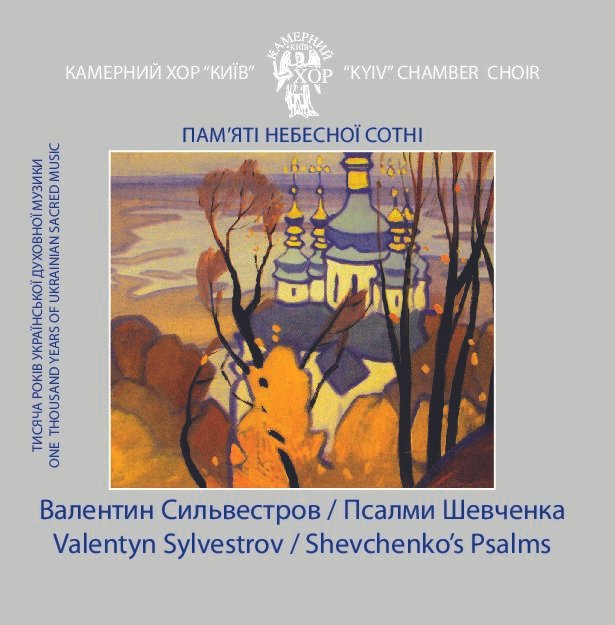
Valentyn Sylvestrov. Shevchenko’s Psalms
- Release: Kyiv Choir Productions
- Released: 2014
- Sound Engineer: Andrij Mokrytskij
- Cover: Painted reproduction by Iurij Khymych “Vydubychi Monastery. Quiet fall ” (Gouache. 1983)
Roars and howls the mighty Dnipro (from Psalms)
A cherry orchard by the house
My musings
Roars and howls the mighty Dnipro (from Tryptyh)
My evening star
Valentyn Sylvestrov/ Taras Shevchenko
Psalms (2005-2013) 36:24
1. Roars and howls the mighty Dnipro 4:09
2. Through the grove the wind wails 7:37
3. The water flows 4:22
4. A cherry orchard by the house 3:36
5. All my hope 6:16
6. In our paradise on earth 3:24
7. My musings 7:00
Elegy (1996) 12:03
8. Quietly the wind blows
Triptych (2013) 12:26
9. Roars and howls the mighty Dnipro 3:04
10. Everyone’s fate is his own 5:29
11. A cherry orchard by the house 3:53
Refrains (2014) 17:06
12. Elegy (The days pass) 5:28
13. Pastoral (A cherry orchard) 4:15
14. Psalm (All my hope) 4:34
15. Evening song (My evening star) 2:49
Total time 78:01
About the Album
It is unusually difficult to find words that might characterize the music of Valentyn Sylvestrov. It must be said therefore, that no words, even the most precise, the most convincing, or the most poetic, will convey the nuances of Sylvestrov’s creativity – such as appear, exist and develop particularly in intonational unspoken spheres. One may speak about external parameters in Sylvestrov’s creative output, as for instance his biographic data. Valentyn Sylvestrov (born 30 September, 1937, in Kyiv) – an eminent Ukrainian composer, national artist of Ukraine (1989), Laureate of the International S. Koussevitzky prize (Washington, 1967), Laureate of the International competition of composers “Gaudeamus” (Netherlands, 1970), Laureate of Ukraine’s National T. Shevchenko prize (1995). He graduated from the Kyiv conservatory in 1964 (under B. M. Ljatoshynskyj). Otherwise one might mention the composer’s priorities of genres: here, until most recently, instrumental music was predominant – from symphonies and vocal-symphonic works to chamber music and works for piano, although lyric chamber vocal music constitutes an essential part of his output. One may trace the external “development” of Sylvestrov (it will be tied to the rejection of rigid and “voguish” canons – of both social-realism and the avant-garde). Thе meaning can be felt forthrightly, by carefully listening to Sylvestrov’s works. It can be understood – best from the commentaries offered by the composer explaining his positions with deep, precise and nuanced insights. Finally, it can be appreciated – by combining attentive listening with unhurried reflection.
Valentyn Sylvestrov’s creative life began in instrumental genres: piano works, instrumental chamber ensembles, symphonic compositions – it was in these spheres that his creativity developed during the 60’s and 70’s. The composer took up choral music somewhat later.
“… I never thought that I would write choral pieces. I had no special interest for choir, being an individualist. The piano — that was to be my fate.”
To these words of the composer it is worth paying special attention. We then will hear in the choral sonorities echoes of romantic pianistic traits; then the plasticity of Sylvestrov’s choral textures will become apparent in its instrumental genesis – instrumental, yet in a wonderfully unfathomable way combined with a lyric cantilena – be it solo, jubilate, or songlike: “… in essence – these are piano pieces, but their keyboard is – people. There we have no line, there we have a situation of choral singing.”
Writing his first a capella work for mixed choir in 1977 – a cantata – V.Sylvestrov was already the author of four symphonies, many instrumental chamber works and the vocal cycle “Quiet songs”. It is noteworthy and significant that this cantata is set to the poetry of T. Shevchenko: “Ukraine subsists on Shevchenko… Shevchenko sustains all of Ukraine with his written words, because these are not just simply words… He authored such texts that show why this language and this nation will never perish… These texts are in essence the independence of Ukraine…”
Let us mention, that in the times when Ukraine did not enjoy its own = statehood, and its nation and lands were incorporated into the Russian or Austro-Hungarian empires, this very poetry of Shevchenko came to the fore as an important factor of national self awareness, that spiritually unified Ukrainians who lived in Podillja, Halychyna, Bukovyna, Kyivschyna, Volyn’ and in Novorossija.
Taras Hryhorovych Shevchenko (1814-1861) lived on this earth for 47 years and a day. Of these he was a serf for 24 years, a further 10 years he spent in exile, and the rest under the scrutiny of the Russian imperial police. Nevertheless, showing his fearlessness, he, the Poet-Kobzar, became for the Ukrainian nation one of the most precious and important spiritual symbols. His role in the national culture is not confined to his status as founder of the new Ukrainian literature and architect of contemporary Ukrainian language. His role is not simply more extensive (poet, artist-painter, societal activist), it is genuinely different in nature. Shevchenko’s Voice became the Voice of the Nation, becoming thereby the first such example in universal literature (not just Ukrainian, but of the world) – this voice coming from a voiceless, speechless – seemingly non-existent man. “This example is unique in history, that a poet became a symbol not only of the struggle for independence, but also a symbol of Ukraine. To these words…”.
Therefore Sylvestrov’s adoption of Shevchenko’s words in his very first choral work is important. The further progress of his choral output is influenced by two motivating attitudes, which harken back to this source. The first – is the approach to Shevchenko’s poetry as to a derivative of the sacred Word: “… the poet-kobzar is also the psalmodist, only in a different sphere…”. The second – is the sensibility to the skillful, unpredictable and always unique relationship of words and music: “Music does not comment on the poetry, but meets with the words; and the verse lives in its own depths and its own diversity, but the music… is the monotony of waters… At first it seems absolutely uniform, but then one begins to differentiate a remarkable variety, which hides behind the uniformity…” It is this direct and momentary illumination of the words by active intonation that forms the unique aura of Sylvestrov’s choral works. This leads to his manifold treatments of the same text: for each of these concrete renditions is but one of an endless line of possible expressions of such a diversity.
These two motivating attitudes flourish in Sylvestrov’s creativity both when he rarely turned to the choral genres as in the mid-90ies (“Diptych”, “Elegy”), and when, after 2005, his choral compositions became dominant in the given time for Sylvestrov’s muse. The function of these attitudes can explain the configuration of Sylvestrov’s choral world, where liturgical waters flow parallel with Shevchenko’s, time and again intermingling with one another. Significant of this is the Diptych (1995). The composer combines here the biblical “Our Father” with Shevchenko’s “Testament”, considering that “…these are two testaments: ‘Our Father’ – from the gospel, is Christ’s answer to how one should pray; this, therefore, is God’s testament. And Shevchenko’s is a secular one. The heavenly and the worldly combined reinforce, seemingly, one the other.
They impact also on the commonalities of their intonational roots, with migrations of genre characteristics – when compositions on secular texts are not only called but also become psalms; and “Songs of the Cherubim”, “Thriceholies” and Well-wishings are incorporated into spiritual cyclical works. So, for example, in the “Elegy” (1996), a setting of a fragment of text from the satiric poem “Dream” (1844), extensive renditions in parallel thirds remind one of the virtuoso melodic ornamentations of “Alleluias”; and in the Triptych (2013) two of the three texts are the same as in the choral cycles “Psalms” (2005-2013).
The seven works which comprise the cycle “Psalms” are based on fragments, prominent in anthologies and often set to music, from Shevchenko’s ballads and poems – “Roars and howls the mighty Dnipro” from the ballad “The madwoman” (1837), “Through the grove the wind wails” from the ballad “The poplar” (1840), a poem inspired by folklore “The water flows” (1847), “All my hope” from the poem “Maria” (1859), the poems “In our paradise on earth” (1849) and “My musings” (1840). From the poet’s texts the composer deletes the dreamlikereflective and the lyrical-contemplative fragments, producing thematically dynamic episodes. The musician avoids the exhortative, imperative expressions (characteristically, leading to an “omission” in Shevchenko’s texts of the “exclamation marks”), time and again appealing to the soft temperament that underlies the core of the Ukrainian mentality: “… For a long time I have felt that some of the fundamental texts, by virtue of which Shevchenko is a great poet… – are the psalms, the psalms of the poet-kobzar only… To these verses I wrote my Psalms…”
Such an intonational aura is characteristic also for the “Triptych” (2013), whose text, as was the case also in the already mentioned poems “Roars and howls the mighty Dnipro” and “A cherry orchard by the house” is based on a fragment from the comedy “Dream”. The compact disc ends with the choral cycle “Shevchenko Songs” (2014). It was composed during the Revolution of Dignity (2014) – and it speaks time and again of the eternal and the most important: about the value of the Individual, of Wisdom, of Faith and of Love. The genre-titles of the cycle’s sections (Elegy, Pastoral, Psalm, Evening Song) circumscribe their spiritual-lyrical sensory domains, and the numerous melodic, harmonic and textural relationships resonate with the boundless scope of European romantic tradition. To the new variant interpretations of the poems “All my hope” and “A cherry orchard” are added: the philosophic poem “The days pass” (1845), and the lyrical chef-d’oeuvre “My evening star” – a fragment from the poem “The princess” (1847).
And everywhere the listener is confronted with a luxury of Melos – organic, natural, nuanced, and rich in allusions, lyrical – yet at the same time rigorous, vocal-cantilena-like – yet also instrumental colorful. The jubilates of church chants abound here amidst a fabric of polyphony, and the parallel thirds of chants combine readily with romantic linguistic intonations. This Melos develops as an echo from the initial chords; it grows, branches out into surprising configurations of sound, creating impressions of living matter: it throbs, breathes, darkens and brightens. It knows neither borders nor constraints, it does not feel the limiting nettings of meter, and it is – self-sufficient and hypnotic. This Melos – unites with the Word of the poetkobzar, with his poetry that is “carved into the nation’s memory” and creates an extraordinary and unique, original and cosmic, and yet a human world: a world of choral Shevchenkiana of Valentyn Sylvestrov.
Jurij Chekan,
Doctor of Arts, Professor