
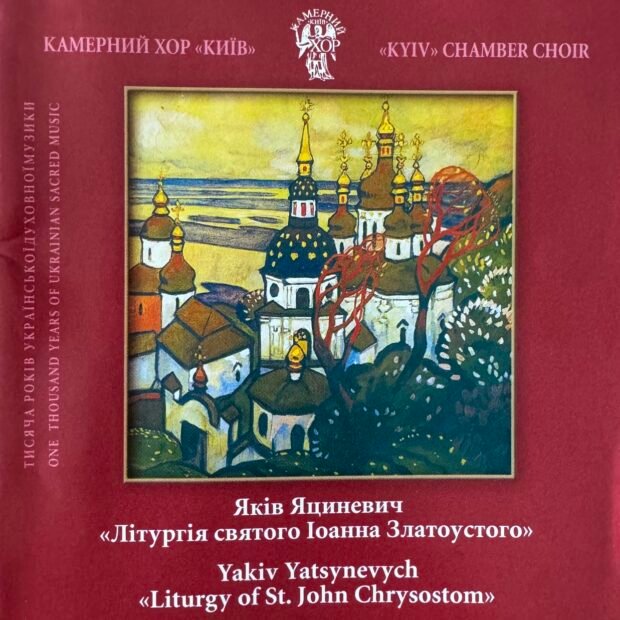
Yakiv Yatsynevych. Liturgy of St. John Chrysostom
- Release: Kyiv Choir Productions
- Released: 2006
- Sound Engineer: Andrij Mokrytskyj
- Cover: Reproduction painting by Yurij Chymych "Spring. Vydubychi". (1992. Gouache)
The Great Litany
Many Years
Liturgy of St. John Chrysostom
The Great Litany
Bless, O my soul, the Lord
Small Litany
Only begotten Son
Small Litany
In thy kingdom come
Come, let us worship
Holy God
Alleluia
Triple Litany
The cherubic song
Litany of supplication
of the Father and of the Son
Grace to the world. To you we sing
We sing to thee
Our Father
One Holy One
Blessed
We have seen the true light
May we be filled
The Litany of Thanksgiving
Let the blessed be
Glory to the Father and to the Son
Perennial
The total time 62:55
About the album
Y. Yatsynevych. Return from oblivion
In the history of culture, there are cases when the figure of a talented artist and his work were forgotten for some reason and remained unknown for a long time. Unfortunately, such a fate befell Yakiv Yatsynevych, a gifted Ukrainian composer, folklorist, musician, and public figure. Only a few of his works were published during his lifetime. Yatsynevych’s legacy has not been fully collected; his compositions are stored in various manuscript departments of Kyiv libraries. Of the artist’s entire oeuvre, only two pieces are currently performed: a choral arrangement of the Ukrainian folk song “Neighbor,” to which he added a chorus, and a spiritual choral work “The Virgin Mary.” Musicologists have not yet given a proper assessment of Yatsynevych’s work, and not everything is clear in his biography.
Yakiv Yatsynevych was born on November 8, 1869, in the city of Bila Tserkva in the Kyiv region. He first received his general and musical education at theological institutions, the Kyiv Sophia Theological School and then the Kyiv Theological Seminary. Yatsynevych had a beautiful voice and bright musical abilities, which led to his invitation to join the metropolitan choir. While still studying, he served as an assistant regent of the choir of St. Michael’s Monastery. This choir was one of the best in Kyiv at the time. After graduating from the seminary (1890), Yatsynevych was appointed regent of the bishop’s choir and the choir of St. Michael’s Monastery. The fact that he was entrusted with the management of these choirs testifies to Yatsynevych’s abilities as a choral conductor and his high professionalism.
In 1891, when Yatsynevych was 32 years old, he began his collaboration with Mykola Lysenko, which lasted until the death of the classic Ukrainian musician. In the period 1891-1904, Yatsynevych was Lysenko’s assistant in his extensive choral activities (organizing choirs and training choristers, performing concerts), which aimed to popularize Ukrainian folk songs and professional music. Together they made three choral trips to Ukraine (1893, 1897, 1902). At the same time, Mykola Vitaliyovych taught Yatsynevych piano, harmony, and musical forms. Communication with Lysenko, an ardent Ukrainian patriot who devoted all his energy to the development of Ukrainian culture, could not but influence Yatsynevych. In his versatile activities and creativity, he became an ardent follower of Lysenko. From 1906 to 1917, Yatsynevych was in charge of the musical part of dramatic and operatic performances at the First Stationary Ukrainian Theater in Kyiv, founded by M. Sadovsky. In 1919, at the invitation of the All-Ukrainian Music Committee, Yatsynevych became the conductor of the Lysenko Choir, but he did not lead it for long due to the war. In 1920, Yatsynevych left Kyiv and taught in the villages of the Kyiv region, where he recorded Ukrainian folk songs, arranged them for the choir, and worked on material from the recordings of other folklorists. Fascinated by his folkloristic work, Yatsynevych applied to the Folklore Commission of the Ukrainian Academy of Sciences to allow him to work in this institution, as he dreamed of publishing the material he had collected. Unfortunately, his request was not granted.
In 1921, Yatsynevych took part in the All-Ukrainian Orthodox Church Council, which proclaimed the creation of the Autocephalous Orthodox Church and the establishment of the All-Ukrainian Orthodox Church Council. These events are associated with Yatsynevych’s writing of the Liturgy, which was published in 1924 by the All-Ukrainian Orthodox Church Council. In 1925, Yatsynevych moved to Odesa, where he lived until 1930.
He worked in various fields: as a conductor, singing teacher, and composer. His works became popular and were performed by various choirs, including the Dumka Choir in Kyiv.
The following period, from 1930 until the composer’s death, was obviously the most difficult in his life. From the surviving materials, it is difficult to find out where Yatsynevych was in 1930-1935. In 1930, his compositions were banned from publication due to the manifestation of what was said to be “churchianity” in his musical language. Perhaps the repressive measures of the Soviet government that began in the 1930s also affected Yatsynevych. In 1935-1940, he worked as a pianist and taught music (mainly in amateur groups) in Zaporizhzhia and Dnipro. In 1940, he moved to the city of Maikop in the Adygea Autonomous Region, where he briefly headed the Adygea Song and Dance Ensemble. But soon, for unknown reasons, he found himself in the village of Koshekhabl in the Krasnodar Territory, where he worked at the music school he created (91940-1943). The surviving documents show that in 1944 Yatsynevych was hired as a watchman for a collective farm garden in the village of Petropavlovska, Krasnodar Territory.
He died in the Krasnodar region, in the town of Kropotkin, far from his homeland on April 25, 1945.
About 170 works by Yatsynevych are kept in the archives of Kyiv. Among them are compositions of various genres, but most of them are choral works. The composer made many arrangements of Ukrainian folk songs (about 70), most of them for mixed a cappella choir. He arranged almost all genres of folk songs.
Yatsynevych wrote about 50 choral works to texts by contemporary poets. Yatsynevych also wrote sacred choral music: “Liturgy,” ‘Wedding,’ and some spiritual hymns. His “Liturgy” has a distinct national identity, as does the sacred music of M. Leontovych and K. Stetsenko. These composers consciously sought to create a new style with vivid national characteristics.
Yatsynevych’s music testifies to the composer’s lyrical talent. The bright melody of his works is connected with this. Their lyrical sphere is full of poetry and tenderness. The composer used the colorful sound of harmony. Yatsynevych’s music is emotionally expressive and nationally distinctive, although the composer did not always use folklore elements. His work fits into the style of late romanticism. These features are reflected in his Liturgy.
The work of Yakiv Yatsynevych, a gifted, highly professional composer, deserves to be published and performed in order to become an asset to Ukrainian musical culture.
Lidia Korniy
Doctor of Arts, professor